Wednesday, 31 December 2014

Dr Demartini on Binge Drinking

Even though we know binge drinking is a dangerous and often destructive habit, why would our peers look up to someone who does it?

When you have a clear, deeply meaningful, inspiring and focused purpose, or chief aim to strive for and fullfil in life, or at least something highly important to get up in the morning for and to achieve each day, you are less likely to be a candidate for peer pressured, teenage minded, activities like binge drinking. It is wiser to fulfill your day with pre-envisioned, high priority actions that inspire you; ones you can’t wait to get up in the morning and get moving on, than to allow yourself to be persuaded to react to irrational pressures from the outside crowd. Do you want to be one of the many sheep who foolishly follow, or the one shepherd who wisely leads? By becoming more fulfilled through focusing on high priorities you will have a lower probability of wanting to escape your unfulfilled existence and wipe out your previous evening by binge drinking. When you don’t have something productive and inspiring to lead your way through life – meaningful actions that also serve others – you will become more vulnerable to outer social peer pressures, hedonism, immediate gratifications and to seeking ways to be an alpha leader by something like binge drinking –the so-called life of the party. When you don’t fill your day with high priority actions that build your self-worth and well-being, your day can become filled with low priority distractions that can destroy your self-worth and well-being. Anyone that would dishonor you by encouraging you to become so extreme, out of control and potentially damaging your brain, health, career and social status, may not be the greatest and truest friend to buddy up or hang out with. Since your social circle can impact your life’s outcomes, it would seem wiser to surround yourself with those who truly care about your long-term mission, dreams and objectives and who desire to contribute to you and the rest of society in productive ways.

How does drinking relate to being seen as the “alpha” in a group? At work among colleagues, especially?

Being an alpha male can be demonstrated or expressed in many ways. Binge drinking is probably one of the least productive and most foolish of them. Leading the way in the form of productive service, rising to the top of some form of business, social, educational or spiritual influence and demonstrating self-governance and social contribution, could be a wiser use of your money, time, effort and energy.  If you could look back at your life 50 – 100 years from now it might be wise to ask yourself if binge drinking is the key action you want to be remembered by and leave as your mark and legacy. The sooner you get on with what is truly most important and meaningful in your complete life, the more momentum you will develop and the greater you will make a difference in the world. Although drinking is one form of social interaction there are many others that you can be a leader in. It takes little education and minimal creative effort to be a leader of drinking, but it takes self-mastery to leave your indelibly mark across the world. The greater your cause, the greater your life will probably be. How do want to be remembered by?

The study finds that binge drinkers are more popular, but what about the converse? Are more popular people more prone to drink — due to certain personality traits? 

The question that might be wise to ask yourself is who are you being more popular in front of or to, and in whose eyes? Being popular in front of, or to someone who desires to escape their unfulfilled life by losing control over their faculties and damaging their brain and body and possibly their future career may just be a foolish form of popularity. A once in a life time teenage experience is one thing – but a regular activity of immediate gratifying hedonism or debauchery is quite another. It is wise to stop and reflect on a larger vision of your life and think of the grander design and see if binge drinking is the wisest use of your social network, time, energy and money. Popular people come in all walks of life, from great achievers, thinkers, singers, dancers, artists, writers, entrepreneurs, and politicians etc., but it is unlikely that any leading binge drinker is going to be respected by many for very long. If you don’t plant flowers in the garden of your mind you may forever pull weeds. It is wiser to be filled with the whole spirit than to be fooled by the party spirit.

http://blog.drdemartini.com/dr-demartini-binge-drinking/

Monday, 29 December 2014

1940s Fashion: The Decade Captured In 40 Beautiful Pictures

Despite the hardships of WWII, fashion in the 1940s still RULED as women everywhere embraced a more utilitarian (yet chic) look, and Hollywood's Golden Age stars - from Rita Hayworth to Katharine Hepburn - dazzled in gorgeous gowns. We highlight the key looks of the decade in 40 stunning images and list our favourite vintage fashion shops so you can get the style yourself...

1. Joan Crawford, 1940s
Check out Joan Crawford's shoulder pads and decadent jewels – now we know where Joan Collins got her Dynasty inspo from. A perfectly-tailored peplum finishes off her sharp look. Power dressing at its very best.


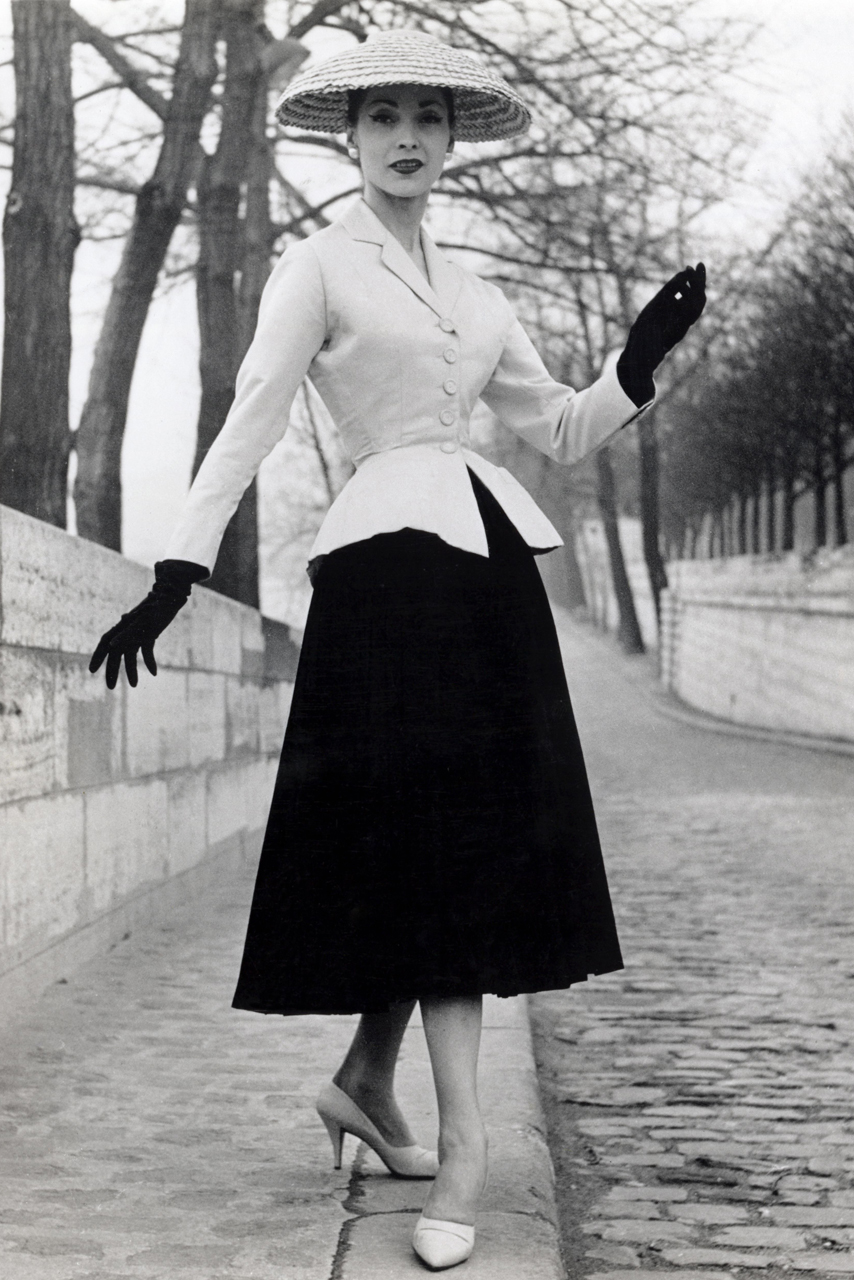
2. Christian Dior's New Look, 1947
Dior's groundbreaking new silhouette redfined women's post-war style and revived France's fashion industry after a difficult few years. The collection – featuring gorgeous full skirts and waist-cinching jackets – was Christian's first and became forever known as the New Look after Harper's editor Carmel Snow said in 1947: 'It's such a new look!' Imagine if every designer could knock together something like this for their debut...


3. Ava Gardner, 1944
Ava Gardner was one of the decade's most successful (and beautiful) actresses. Here she is in 1944, showcasing the beauty of a belted waist and a chic neckerchief.


4. Bette Davis, 1943

An original pin-up girl, Bette Davis works a blue gown in this seductive shot, taken in 1943.


5. Doris Day, 1948
Doris Day shows us how to work the nautical trend during the filming of Romance On The High Seas in 1948. Remind us to drape our blazer over our shoulders on our next boat trip...


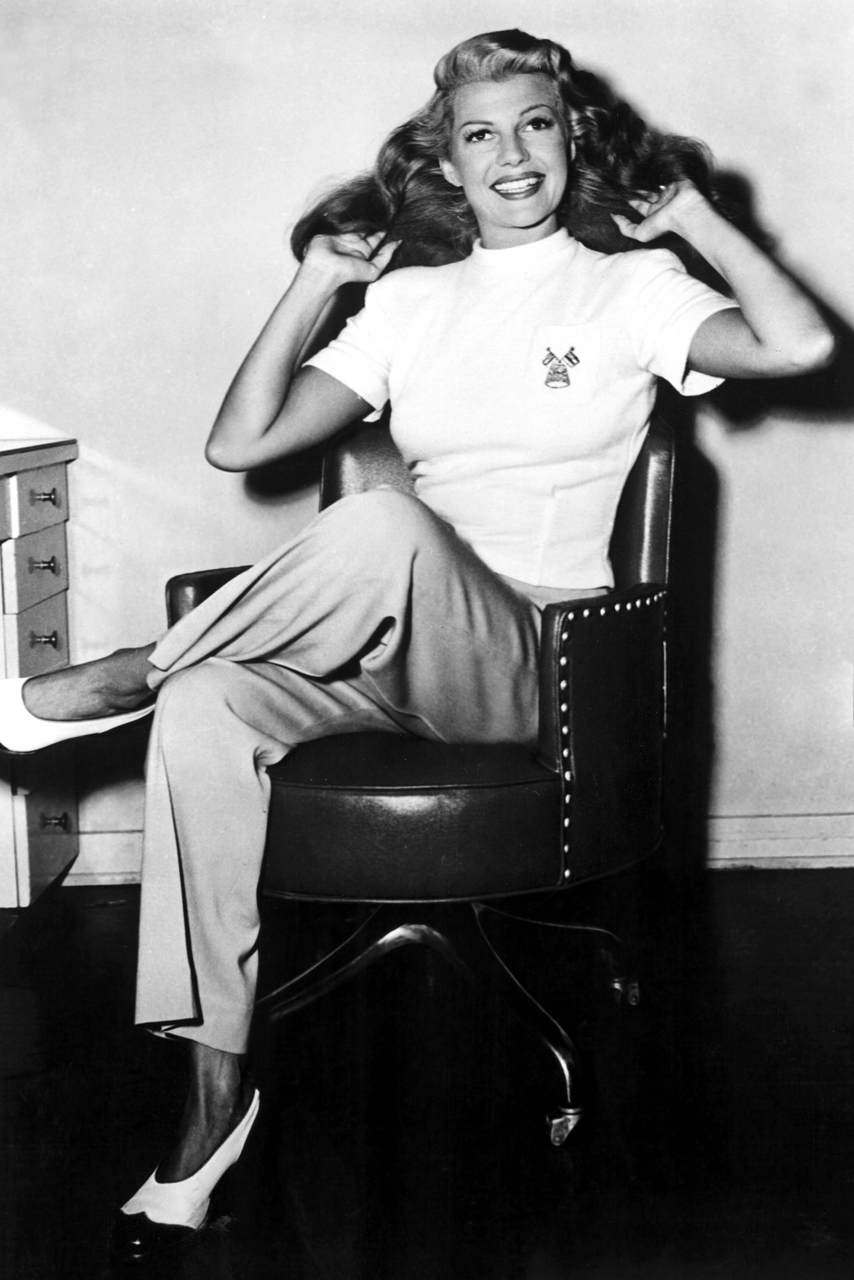
6. Rita Hayworth, 1940
The actress embraces androgynous style in a pair of wide-legged trousers and monochrome flats in 1940. Our new workwear wardrobe = sorted.


7. Katharine Hepburn, 1940
Katharine rocks a gingham dress and cinched-in waist on the set of The Philadelphia Story in 1940. Note the Peter Pan collar.


8. Joan Crawford, 1946
Joan does it again. Here she shows us how to work floral prints with some seriously statement jewels.


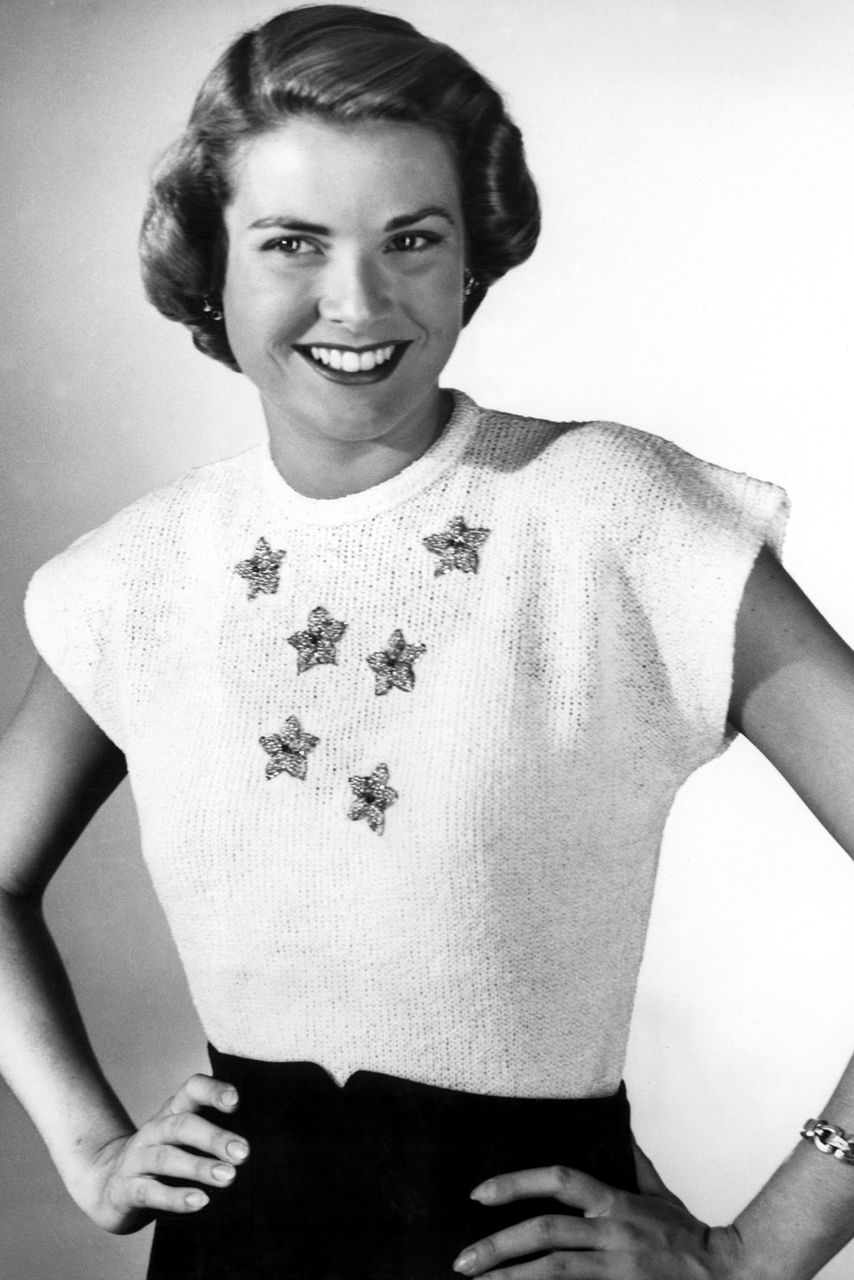
9. Grace Kelly, 1947

Princess Grace Of Monaco always looked flawlessly chic - even as a teen model in 1947.


10. Ginger Rogers, 1942

That wide-brimmed hat and elegant skirt suit made Ginger Rogers look effortlessly pulled-together in 1942. And check out those leather driving gloves. If only we looked this good on our way to the airport.


11. Barbara Stanwyck, 1941

Uber-embellishments and major cocktail jewels made Barbara Stanwyck look like a total screen goddess in 1941.


12. Rita Hayworth, 1946

This famous black satin gown from Rita Hayworth's striptease scene in Gilda set tongues wagging in 1946.


13. Ingrid Bergman, 1942

We'd wear those block-heeled sandals today. Check out the flawless Ingrid Bergman working a perfect 'jet set' look in Casablanca.


14. Bette Davis, 1940s

Bette Davis knew how to clash her brights right, topping off her look off with a slick of red lipstick.


15. Rita Hayworth, 1940s
Here's our Ibiza style inspiration sorted. Rita Hayworth works a printed bikini, huge sun hat and peep-toe heels. If only we looked this put-together by the pool.


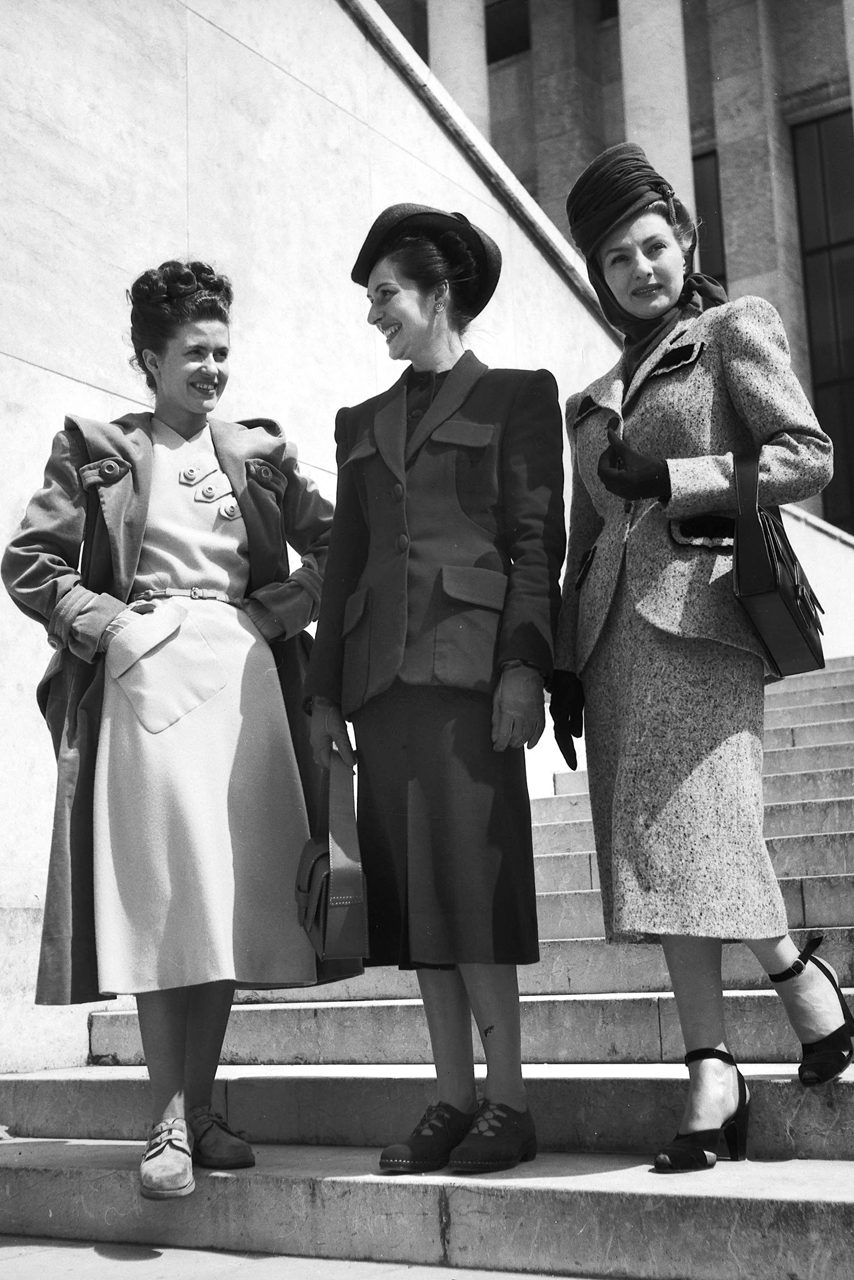
16. Ladies In Paris, 1947

These midi-length skirts couldn't be more on trend for AW14. Have French women EVER been out of style?


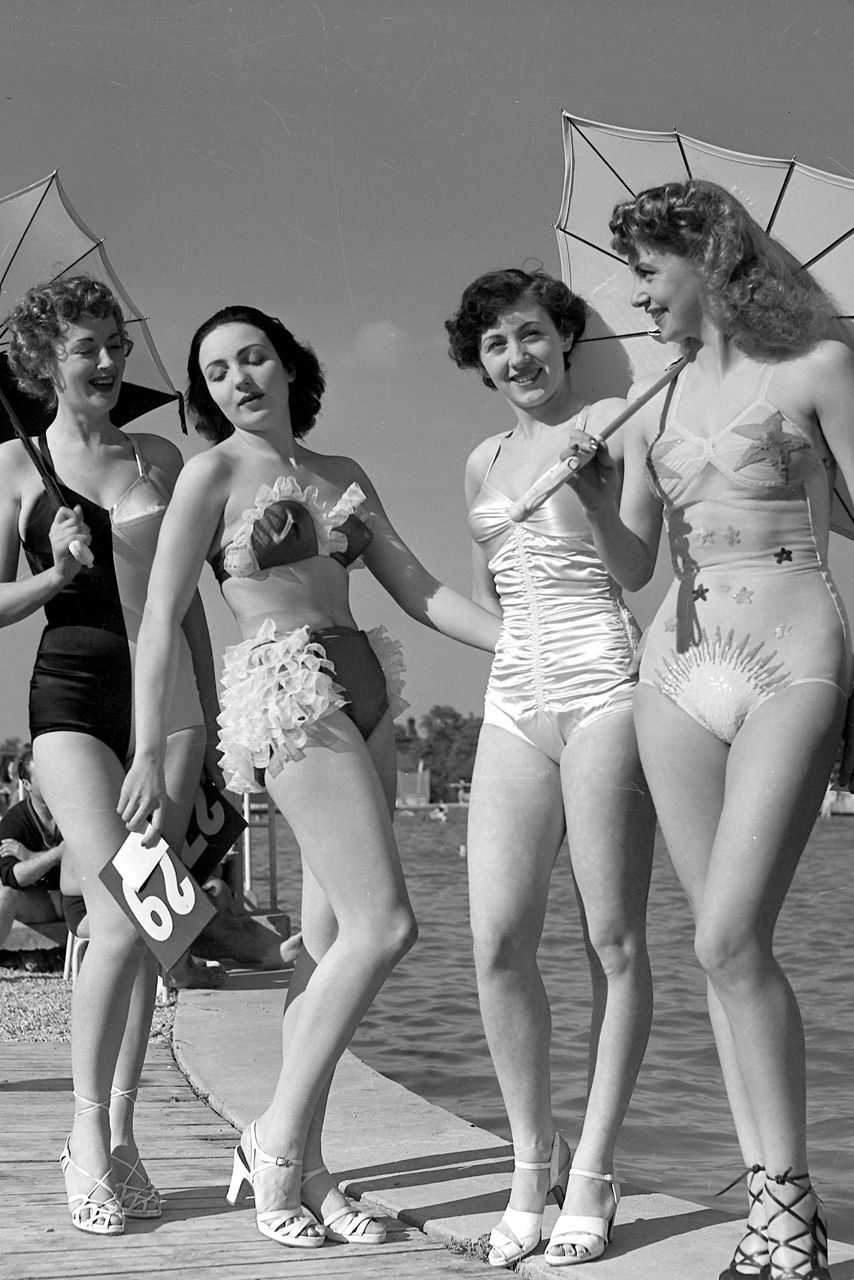
17. Swimsuit Competition, Paris, 1949

CHECK OUT THOSE RUFFLES. And don't get us started on the sun-bursting lady-parts. These Parisian girls certainly knew how to push boundaries when they showcased the latest swimsuit trends way back in 1949. We could totally see Rihanna in the suit on the far right.


18. Christian Dior Model, 1947

Has a fur coat ever looked so glamorous? This lady seems to have predicted exactly how we want our winter layers to look, 60 years into the future. How clever.


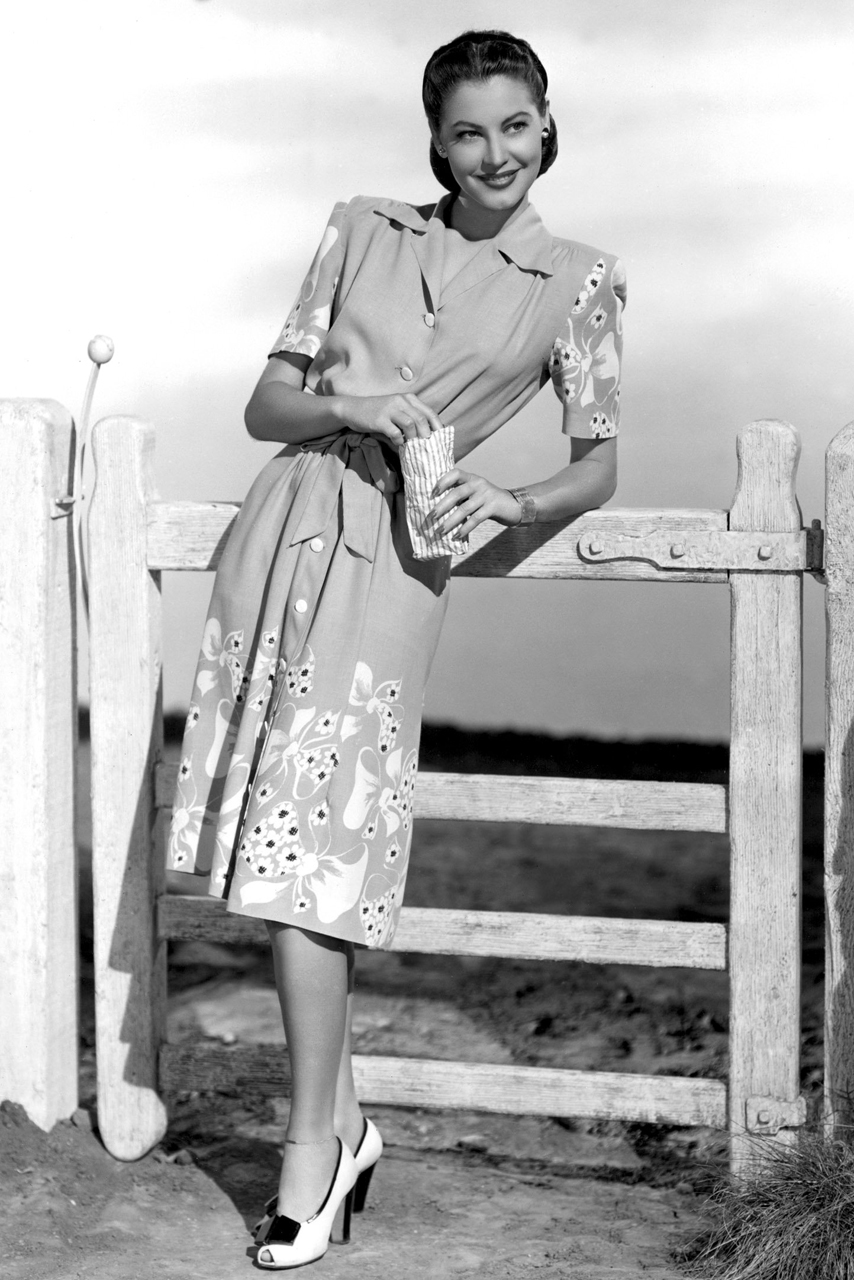
19. Ava Gardner, 1940s

More monochrome. A first hint of statement prints. You can't go wrong with a 1940s tea dress.


20. Betty Hutton, 1945

Betty rocks a halterneck bikini, wrap skirt and wedges with a turban-style headband. No wonder she's smiling - she looks HOT.

21. Ann Sheridan, 1942

Ann works the metallics trend in this decadent high-neck gown. We could totally see this on the red carpet at next year's Oscars.


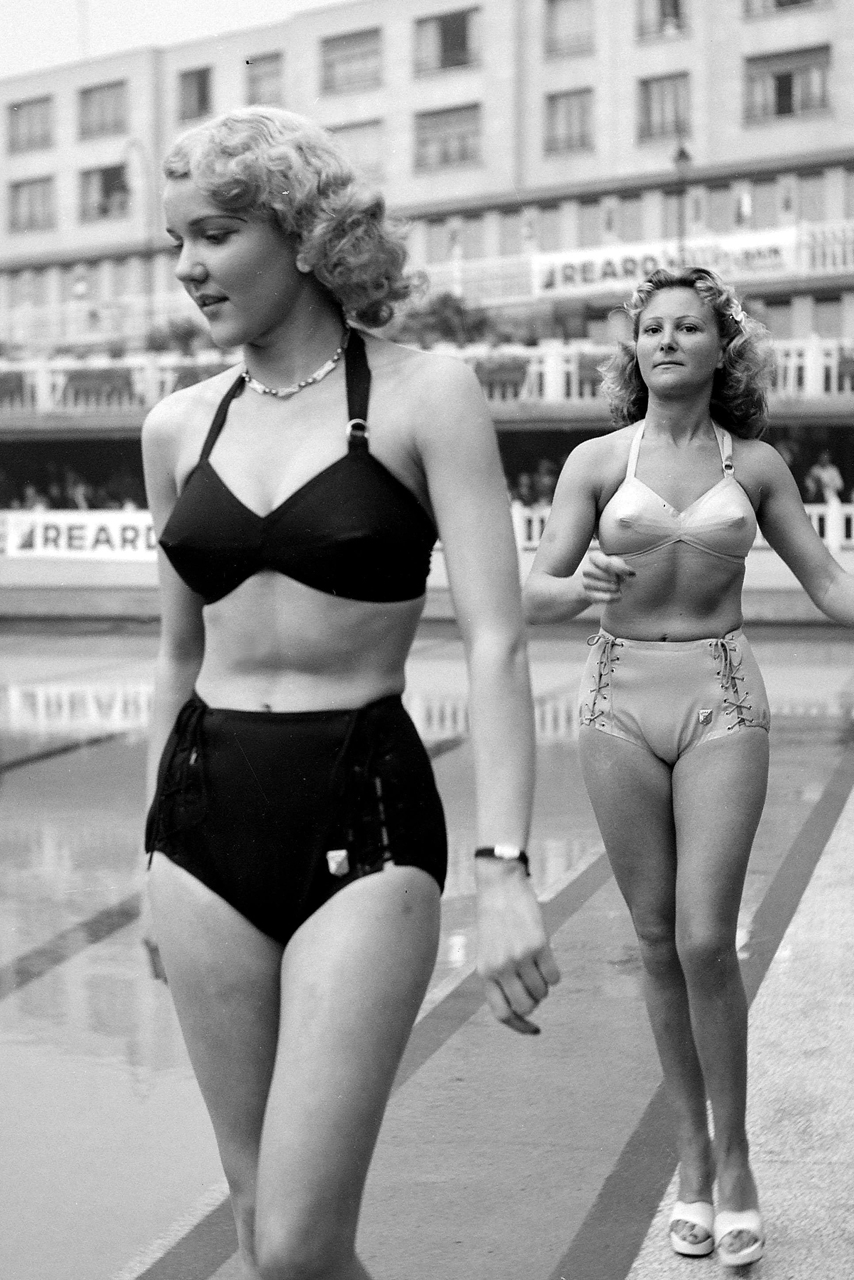
22. Reard Fashion Show, 1946

Bikini briefs in the forties were HUGE (no, literally) and always teamed with an, ahem, on-point structured top. These gorgeous models perfect their catwalk struts at the Reard show in 1946.


23. Betty Grable, 1940s

We love the bright acid yellow of actress Betty Grable's bathing suit. And that's before we even mention that hair.


24. Lucille Ball, 1940s

This actress knew how to offset her bright red barnet and sparkling blue eyes with a pair of statment earrings. And let's talk about that pre-Photoshop complexion - flawless!


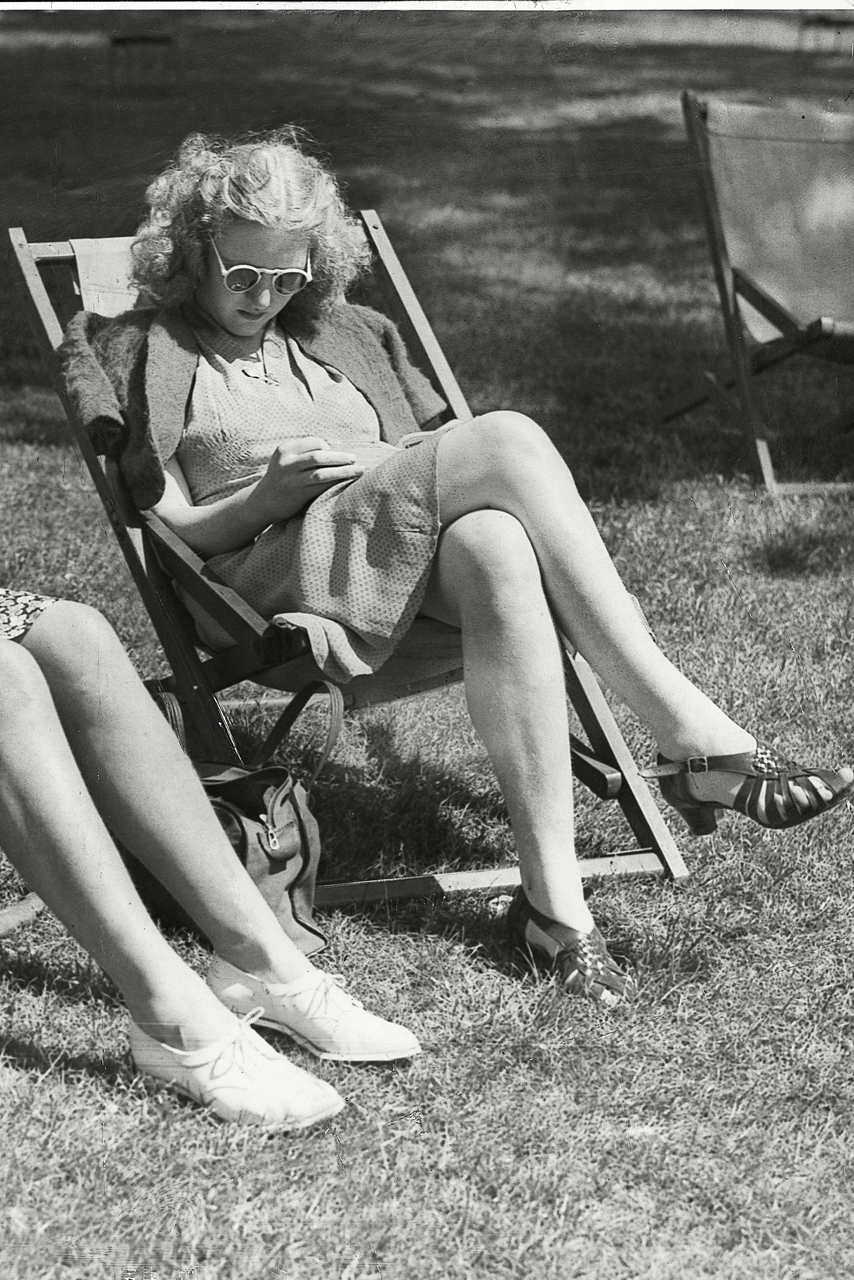
25. Ladies Sunbathing In London, 1942

These girls owned a relaxed look while chilling in a park in 1942. As rationing went on around them, a real tan was surely the perfect alternative to stockings? And check out those John Lennon-style round sunglasses. This scene would not look amiss on Primrose Hill in 2014.


26. Brenda Marshall, 1940s
Pleats, zips, ruching, AND statement headwear? So many trends. An outstanding example of 1940s drapery.


27. Models On Bond Street, London, 1942

The wartime look in Britain became much more austere as the years went by. This was the first collection of Utility Dresses For Women, designed by Norman Hartnell in 1942, and showcased on a very quiet Bond Street.


28. Land Girl In Southern England, 1944

British women headed to the fields during WWII in dungarees and buttoned-up shirts. The Land Girls still kept things stylish though, cinching-in their waists with classic belts.


29. Hedi Lamarr, 1941

Actress Hedi rocks a huge floral corsage for Come Live With Me. So this is where Carrie Bradshaw got her inspiration from...


30. Lana Turner, 1946

Another stunning shot, another turban. Lana's pastel wardrobe for The Postman Always Rings Twice is simply stunning.


31. Lana Turner, 1943

...and she knew all about the importance of diamonds.


32. Lauren Bacall, 1944

Lauren looks flawless in this thigh-split satin gown in 1944. We could totally see Angelina Jolie wearing this vintage wonder.


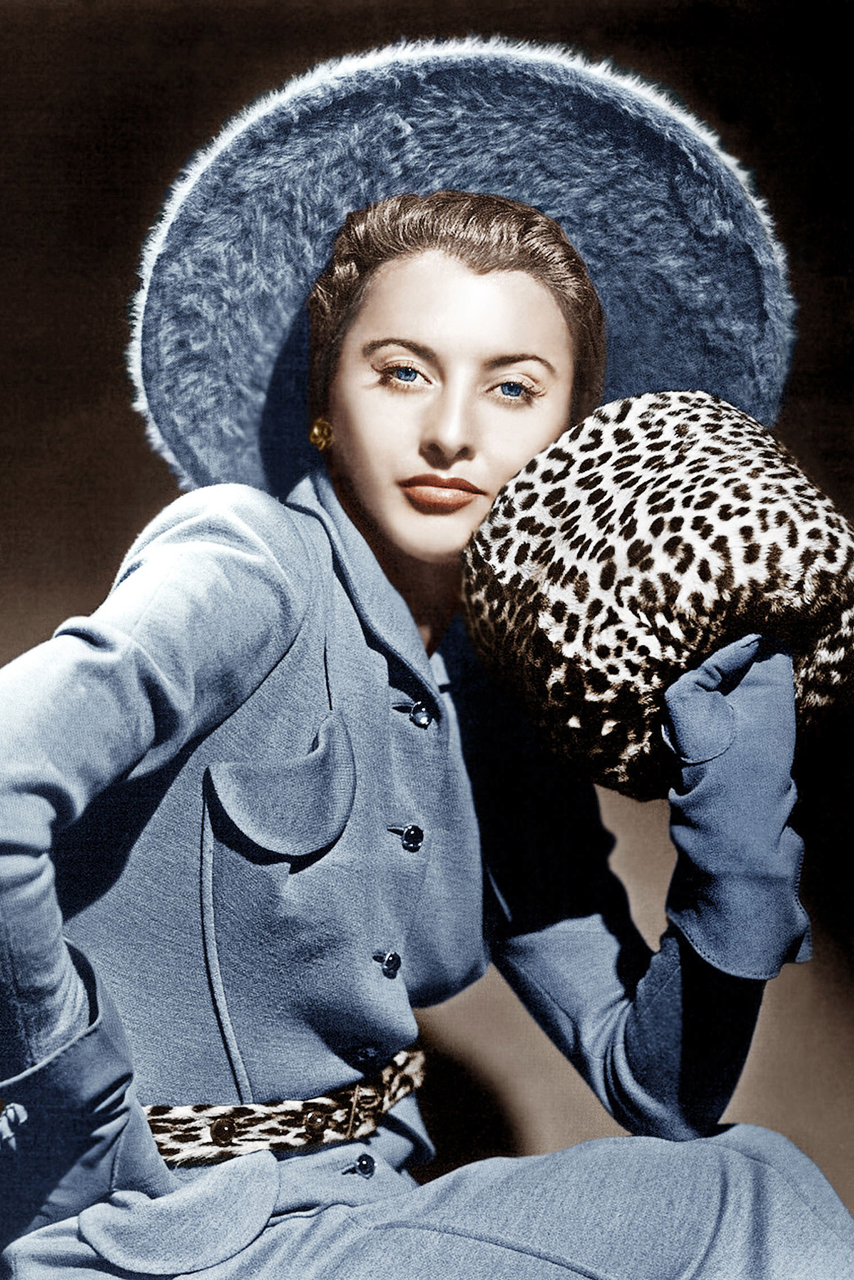
33. Barbara Stanwyck, 1940

Barbara rocks a tailored pastel blue suit in 1940 with a few pops of leopard print to accessorise. Lovely.


34. Betty Grable, 1943
World War II pin-up Betty's white one piece and understated gold jewellery is totally chic. And just look at those curves.


35. Claudette Colbert, 1941
Dear modern-day designers, can someone please re-make this? French actress Claudette rocks a gorgeous striped bikini in 1941.

36. Doris Day, 1945

We just love Doris' preppy chic style and her gold wedges.


37. Ginger Rogers, 1942

Ginger knew all about the power of embellishment. This was her official portrait taken by Paramount Studios.


38. Ida Lupino, 1940s

Actress-turned-director Ida rocks a printed crop top and matching skirt. And how fabulous is that cigarette holder? So sophisticated.


39. Olivia de Havilland, 1941

The crop top was a big look in the early forties, too. We adore Olivia's impossibly glamorous jewels.


40. Claudette Colbert, 1942

Claudette looks fabulously decadent in a floor-length pink gown, while filming The Palm Beach Story in 1942. Haven't we seen Cheryl Cole rocking an elegant cowl hood just like this in a certain music video?


http://www.marieclaire.co.uk/blogs/544203/1940s-fashion-the-decade-captured-in-40-incredible-pictures.html

Sunday, 28 December 2014

Just one 10-second kiss transfers 80 million bacteria

In the 1960s, a singer named Betty Everett belted, "If you wanna know if he loves you so, it's in his kiss!" Covered by Cher in the 1990s, the song neglects to mention what is also "in his kiss" - 80 million bacteria, according to a new study published in the journal Microbiome.

Couple kissing
What is "in his kiss"? According to the latest study, 80 million bacteria.
Before germaphobes swear off kissing forever, it should be noted that over 100 trillion microorganisms naturally live in our bodies. Called the microbiome, they are vital for digesting food, synthesising nutrients and preventing disease.
The researchers - led by Remco Kort, of TNO (Netherlands Organisation for Applied Scientific Research) and adviser to the Micropia museum of microbes in the Netherlands - note that a number of different factors are important for shaping our individual microbiota, including genetic relatedness, diet and age.
But our surroundings - including the individuals with whom we interact - also affect our microbiota. The team notes that our mouths themselves contain over 700 varieties of bacteria, and these are also influenced by those we are closest to - particularly our romantic partners.
Kort says that as far as he and his colleagues know, "the exact effects of intimate kissing on the oral microbiota have never been studied. We wanted to find out the extent to which partners share their oral microbiota, and it turns out, the more a couple kiss, the more similar they are."

Probiotic bacteria in partner's mouth rose threefold after kiss

To further study how kissing affects oral microbiota, Kort and his team assessed 21 couples who completed questionnaires on their kissing behaviour, including average intimate kiss frequency.
"Intimate kissing involves full tongue contact, and saliva exchange appears to be a courtship behaviour unique to humans and is common in over 90% of known cultures," he says.
The researchers cite a recent study detailing the importance of kissing in human mating, which proposes that the "first kiss" serves to assess a potential mate. They add:
"Kissing may contribute in mate assessment and bonding via sampling of chemical taste cues in the saliva, including those resulting from the metabolic activity of the bacterial community on the surface of the tongue."
After taking swab samples to determine the composition of each individual's oral microbiota on the tongue and in the saliva, the researchers found that when couples intimately kiss at high frequencies, their salivary microbiota become similar. In fact, nine intimate kisses per day was linked to couples having "significantly shared salivary microbiota."
In order to quantify bacteria transfer, one individual from each couple drank a probiotic beverage with specific varieties of bacteria called Lactobacillus and Bifidobacteria.
Results showed that after kissing intimately, the quantity of probiotic bacteria in the other individual's saliva rose threefold, and during a 10-second kiss, a total of 80 million bacteria were transferred.
"This study indicates that a shared salivary microbiota requires a frequent and recent bacterial exchange and is therefore most pronounced in couples with relatively high intimate kiss frequencies," write the authors.

Saliva bacteria 'only transiently present,' while tongue bacteria stay long term

Another finding from the study reveals an essential role for mechanisms behind selection of oral microbiota - particularly those on the tongue. Though tongue microbiota were more similar among partners than unrelated individuals, the similarity was not altered with more frequent kissing, which is in contrast to microbiota found in saliva.
The researchers further explain:

"Our findings suggest that the shared microbiota among partners is able to proliferate in the oral cavity, but the collective bacteria in the saliva are only transiently present and eventually washed out, while those on the tongue's surface found a true niche, allowing long-term colonisation."
To calculate the number of bacteria that are transferred during a kiss, the researchers used average transfer values and assumptions related to bacterial transfer, kiss contact surface and the value for average volume of saliva.
Medical News Today recently reported on a study that suggested saliva protects teeth against cavities more than we previously thought.
http://www.medicalnewstoday.com/articles/285563.php

Friday, 26 December 2014

7 Ways to Get Rid of Negative Energy and Become Positive

Negativity affects ourselves and everyone around us. It limits our potential to become something great and live a fulfilling, purposeful life. Negativity has a tangible effect on our health, too. Research has shown that people who cultivate negative energy experience more stress, more sickness, and less opportunity over the course of their lives than those who choose to live positively.

When we make a decision to become positive, and follow that decision up with action, we will begin to encounter situations and people that are also positive. The negative energy gets edged out by all positive experiences. It’s a snowball effect. Although negative and positive thoughts will always exist, the key to becoming positive is to limit the amount of negativity that we experience by filling ourselves up with more positivity.

Here are some ways to get rid of negativity and become more positive.

Become grateful–for everything

When life is all about us, it’s easy to believe that we deserve what we have. An attitude of entitlement puts us at the centre of the universe and sets up the unrealistic expectation that others should cater to us, our needs, and our wants. This vain state of existence is a surefire way to set yourself up for an unfulfilled life of negativity. People living in this sort of entitlement are “energy suckers”–they are always searching for what they can get out of a situation.

People that don’t appreciate the nuances of their lives live in a constant state of lacking. And it’s really difficult to live a positive life this way.

When we begin to be grateful and appreciate everything in our lives–from the small struggles that make us better, to the car that gets us from A to B every day–we shift our attitude from one of selfishness, to one of appreciation. This appreciation gets noticed by others, and a positive harmony begins to form in our relationships. We begin to receive more of that which we are grateful for, because we’ve opened ourselves up to the idea of receiving, instead of taking. This will make your life more fulfilling, and more positive.

Laugh more–especially at yourself

Life gets busy, our schedules fill up, we get into relationships, and work can feel task oriented and routine-driven at times. Being human can feel more like being a robot. But having this work-driven, serious attitude often results in negative and performance oriented thinking. Becoming positive means taking life less seriously and letting yourself off the hook. This is the only life that you get to live–why not lighten up your mood?

Laughter helps us become positive by lightening our mood and reminding us not to take life so seriously. Are you sensitive to light sarcasm? Do you have trouble laughing at jokes? Usually, people who are stressed out and overly serious get most offended by sarcasm because their life is all work and no play. If we can learn to laugh at ourselves and our mistakes, life will become more of an experiment in finding out what makes us happy. And finding happiness means finding positivity.

Help others

Negativity goes hand in hand with selfishness. People that live only for themselves have no higher purpose in their lives. If the whole point of this world is only to take care of yourself and no one else, the road to a long-term fulfillment and purpose is going to be a long one.
Positivity accompanies purpose.

The most basic way to create purpose and positivity in your life is to begin doing things for others. Start small; open the door for the person in front of you at Starbucks or ask someone how their day was before telling them about yours. Helping others will give you an intangible sense of value that will translate into positivity. And people might just appreciate you in the process.

Change your thinking

We can either be our best coach or our best enemy. Change starts from within. If you want to become more positive, change the wording of your thoughts. We are the hardest on ourselves, and a stream of negative self talk is corrosive to a positive life.

The next time you have a negative thought, write it down and rephrase it with a positive spin. For example, change a thought like, “I can’t believe I did so horribly on the test–I suck.” to “I didn’t do as well as I hoped to on this test. But I know I’m capable and I’ll do better next time.”
Changing our self-talk is powerful.

Surround yourself with positive people

We become most like the people that we surround ourselves with. If our friend group is full of negative energy-suckers and drama queens, we will emulate that behavior and become like them. It is very difficult to become more positive when the people around us don’t support or demonstrate positive behavior.

As you become more positive, you’ll find that your existing friends will either appreciate the new you or they will become resistant to your positive changes. This is a natural response; change is scary. But cutting out the negative people in your life is a huge step to becoming more positive. Positive people reflect and bounce their perspectives onto one another. Positivity is a step-by-step process when you do it solo, but a positive group of friends can be an escalator.

Get into action

Negative thoughts can be overwhelming and challenging to navigate. Negativity is usually accompanied by a “freak-out” response, especially when tied to relationships, people and to worrying about the future. This is debilitating to becoming positive and usually snowballs into more worry, more stress and more freak-outs.

Turn the negative stress into positive action. The next time you’re in one of these situations, walk away and take a break. With your eyes closed, take a few deep breaths. Once you’re calm, approach the situation or problem with a pen and pad of paper. Write out four or five actions or solutions to begin solving the problem. Taking yourself out of the emotionally charged negative by moving into the action-oriented positive will help you solve more problems rationally and live in positivity

Take full responsibility; stop being the victim

You are responsible for your thoughts. People that consistently believe that things happen to them handicap themselves to a victim mentality. This is a subtle and deceptive negative thought pattern. Phrases like “Ihave to work” or “I can’t believe he did that to me” are indicators of a victim mentality. Blaming circumstances and blaming others only handicaps our decision to change something negative into something positive.

Taking full responsibility for your life, your thoughts and your actions is one of the biggest steps in creating a more positive life. We have unlimited potential within to create our own reality, change our life, and change our thoughts. When we begin to really internalize this, we discover that no one can make us feel or do anything. We choose our emotional and behavioural response to people and circumstances.
Make positive choices in favour of yourself.
Watch your thoughts; they become words.
Watch your words; they become actions.
Watch your actions; they become habit.
Watch your habits; they become character.
Watch your character; it becomes your destiny
― Lao Tzu

http://www.lifehack.org/articles/communication/7-ways-get-rid-negative-energy-and-become-positive.html

Thursday, 25 December 2014

5 Absolutely Fabulous Moments That Still Make Us Die Laughing

It's been over 20 years since Patsy and Eddie first stumbled drunkenly into our lives, and they can still put us in stitches. Sweetie, darling, they're absolutely fabulous.

1. Mother-daughter bonding at its best.

Ab Fab Saffy vs.Eddy (never be anyone as fat as you)


2. You don't mess with Patsy Stone...

Patsy Stone - I will kill you


3. The concept of a wallet is hard to grasp sometimes.

Absolutely Fabulous - Identity - "It's a Wallet"


4. 'Oh, it's very recent'

ab fab patsy's passport


5. The Ab Fab girls know how to travel in style...

Patsy motorbike


http://www.marieclaire.co.uk/blogs/544588/9-absolutely-fabulous-moments-that-will-make-us-die-laughing.html

Wednesday, 24 December 2014

Could a hug a day keep infection at bay?


When feeling down, a hug from a friend or a loved one can really lift those spirits. But a new study finds hugging may do more than make us feel better emotionally; it could help protect against viruses, such as the common cold.
A happy couple hugging
Hugging was found to play a role in protecting study participants against a common cold virus, while more frequent hugging was linked to lower severity of symptoms.
Lead author Sheldon Cohen and colleagues, of the Dietrich College of Humanities and Social Sciences at Carnegie Mellon University in Pittsburgh, PA, found that frequent hugging - alongside good social support - may lower stress-induced susceptibility to infection, preventing or reducing the risk of illness.
The study - published in the journal Psychological Science- stemmed from the idea that hugging provides social support, as it represents having a close relationship with another person.
Cohen explains that past research has shown that people engaged in continuous conflict with others are less able to fight off cold viruses, while those who have social support appear to be protected from the psychological effects of stress, such as anxiety and depression.
"We tested whether perceptions of social support are equally effective in protecting us from stress-induced susceptibility to infection and also whether receiving hugs might partially account for those feelings of support and themselves protect a person against infection," he adds.

Hugs linked to lower risk of infection from cold virus

To reach their findings, the team asked 404 healthy adults to complete a questionnaire designed to determine their perceived social support. In addition, the participants engaged in 14 consecutive evening telephone interviews with the researchers, in which they discussed their conflicts with others and hugs they had received.
Next, subjects were deliberately exposed to a common cold virus and placed in quarantine while the researchers assessed any signs of infection and illness.
The researchers found that participants who reported having greater social support while experiencing conflicts were less likely to be infected by the cold virus, and hugs were found to be responsible for around a third of this protective effect.
What is more, participants who did become infected with the cold virus and who reported having greater social support and more frequent hugs displayed less severe symptoms than those who reported lower social support and fewer hugs, regardless of whether they experienced conflicts or not.
Cohen says these findings suggest that receiving a hug from a trusted person may trigger a sense of social support, and hugging more frequently could reduce the damaging effects of stress. Explaining the potential reasons behind this, he says:
"The apparent protective effect of hugs may be attributable to the physical contact itself or to hugging being a behavioural indicator of support and intimacy. Either way, those who receive more hugs are somewhat more protected from infection."

Unlike hugging, kissing does not appear to have protective effects against infection. Last month, Medical News Today reported on a study that found just one kiss for 10 seconds transfers around 80 million bacteria.
http://www.medicalnewstoday.com/articles/287242.php

Monday, 22 December 2014

Social anxiety disorder: how to cope during the holiday season

This the season to be jolly, and for most people, this means attending an array of gatherings with family, friends and work colleagues. But while many of us look forward to such festivities, it is a different story for people with social anxiety disorder.
A distressed woman
Around 15 million American adults are affected by social anxiety disorder - fear or anxiety about social situations.


"Social anxiety disorder is characterised by the presence of fear or anxiety about social or performance situations in which the person is exposed to possible scrutiny by others," Dr. Kalina Michalska, a research fellow in the Section on Developmental and Affective Neuroscience at the National Institute of Mental Health (NIMH), told Medical News Today.
"The individual overestimates their likelihood of being rejected and frequently fears that he or she will act in a way that will be embarrassing and humiliating," she added.
Of course, all of us have experienced shyness or nervousness in certain situations - when having to make a presentation to colleagues at work, for example, or when meeting people for the first time.
However, people with social anxiety disorder - also referred to as social phobia - worry so much about communal situations that the condition can become disabling, severely affecting their work, social life and relationships.

The symptoms and causes of social anxiety

Social anxiety disorder affects more than 15 million adults in the US, and onset is most common during early adolescence.
Symptoms of the condition include anxiousness around other people, the inability to talk to others, self-consciousness, fear that others will judge them, and severe anxiousness days or weeks prior to a social event.
"Physical symptoms can include increased heart rate, muscle tension, dizziness, difficulty breathing, sweating, shaking and feeling sick," Sam Challis, of UK mental health charity Mind, told MNT.
"If you experience social anxiety, you might also avoid situations that could trigger your anxiety, such as meeting up with friends, going out shopping or even answering the phone," he added.
The severity of social anxiety disorder varies; some people with the condition may fear specific social situations, such as speaking or eating in public, while others may have a phobia of all social situations, even experiencing intense anxiety around close family members.
If an individual experiences symptoms of social anxiety for 6 months or more, this usually leads to a diagnosis of social anxiety disorder. But according to the Anxiety and Depression Association of America (ADAA), around 36% of individuals with social anxiety disorder report having symptoms for 10 years or more before seeking help.
"Many people wait too long before seeing their general practitioner, discounting social anxiety as just day-to-day stress," Challis noted. "But it's not the same as being 'a bit shy,' and it's important to seek help as soon as possible if you feel like your anxiety is interfering with your ability to do the things you normally would."
The exact causes of the disorder are unclear, although past research has suggested that people with a family history of social anxiety may be at higher risk. It is unknown whether this is down to genetics, however, or a result of learned behaviour.
Other studies have indicated the disorder may be triggered by overactivity in a brain structure called the amygdala, which plays a role in regulating fear response.

Social anxiety often 'overlooked' as a mental illness

But despite around 7% of the US population living with social anxiety disorder, many health care professionals believe the condition is often surpassed as a mental health problem.
"Socially anxious people are often discounted as merely being shy or introverted. Other times, their behavior can be misinterpreted as aloof or uninterested," Dr. Michalska told MNT, adding:
"Because most of us feel shy or even moderately socially anxious in certain situations, social anxiety can sometimes be overlooked as a mental illness.
Even though it is commonly perceived as less severe than other forms of psychopathology, such as schizophrenia or psychosis, research shows that it is associated with a variety of serious adverse outcomes, including development of other psychiatric disorders such as major depression and suicide."
Social anxiety disorder has also been linked to increased risk of substance abuse - particularly excessive alcohol consumption. According to the ADAA, around 20% of people with social anxiety disorder are alcohol dependent, using alcohol as a tool to cope with their symptoms and relax in social situations.
Dr. Michalska told us there needs to be increased awareness surrounding the seriousness of social anxiety disorder.
"Ironically," she said, "people with social anxiety are less likely to speak about their anxieties in public, but giving them more of a public voice - potentially in writing - will help others understand and empathise with how debilitating this illness can be."

The social challenges of the festive season

Although people with social anxiety disorder can find social situations difficult at any time of year, the festive season is particularly challenging.
A group of people having a Christmas meal

Due to increased social demands over the festive period, this time of year is particularly challenging for people with social anxiety disorder


"People with social anxiety disorder have difficulty in any large groups, which tend to be a staple of the holiday season," explained Dr. Michalska. "It is also a time when people are expected to be with family and friends."
She added that people with social anxiety disorder tend to avoid socialising in large groups during the festive period out of fear that they will humiliate themselves or be judged by others, but that bypassing such situations only fuels their anxiety further.
A good example of this is given in an article from BBC News last December, in which a 38-year-old woman with social anxiety disorder said: "Most years, I buy a ticket for the work [party]. I actually buy the ticket, knowing full well I won't go. I buy [it] to make sure people don't think I'm tight-fisted, or that I hate Christmas, or that I don't like their company."
Others with social anxiety disorder may even avoid spending the holidays with their own families. "People can suffer with social anxiety in the family unit," Dr. Gillian Butler, a consultant clinical psychologist in the UK and author of the book Overcoming Social Anxiety and Shyness, told BBC News. "You may, as an older person, feel a real fool talking to the children. It can bring back memories of adolescence and embarrassing times in the past."

Tips to reduce social anxiety during the holiday season

There are, however, a number of strategies that may help people with social anxiety disorder better cope with social challenges during the holiday season.
Dr. Michalska told MNT that anticipating what social events may arise that trigger social anxiety and planning how to deal with such situations in advance could reduce anxiousness.
"For instance," she added, "at an office holiday party, a socially anxious person might consider inviting a friend for support or letting one trusted person know how difficult it is to interact in social situations and asking them for emotional support. That person might then help buffer interactions with a particularly difficult individual. Most people are honoured to be a source of comfort and feel affinity to those they help out."
Challis said it is also wise to talk about any anxiousness with friends or family:
"It's key not to take too much on and to be honest with people close to you if you are finding it difficult to cope. Keeping anxiety bottled up can make things worse, so find someone you can confide in and let them know that you need some support."
Dr. Michalska told us that people with social anxiety should try to focus on external areas of a social event, rather than how they feel about it personally. For example, she said that if an event is being hosted at a friend's home, they could ask whether they can do anything to help - such as prepare a dessert.
"If they can explain that having something to do is more comfortable for them, most people will be more than happy to accommodate - and have an extra pair of hands to help!" she said. "The key is for the person to not stay at home, even if they are anxious. Avoidance of social situations only leads to more anxiety."
Challis said it is also important that people with social anxiety are healthy over the holiday season. "Festive fare is notoriously high in sugar, fat, caffeine and alcohol, all of which can impact on energy and anxiety levels," he added. "Even making small changes to your diet, such as having a breakfast of porridge, which releases energy more slowly, can help keep anxiety levels in check."

How friends and family can help

Unsurprisingly, many people with social anxiety disorder will not talk about their worries with others out of fear that they will provoke a negative reaction.
As such, it is important that friends and family of those with the condition recognize the symptoms and encourage them to seek help. "One important step is to learn about what social anxiety disorder is and the strategies that are helpful in the long run, including seeking out treatment," said Dr. Michalska.
Treatment for the condition may involve cognitive behavioral therapy (CBT), which teaches a person how to think, behave and react in various social situations in order to reduce anxiety. Medications such as anti-anxiety drugs and antidepressants may also be used to treat social anxiety disorder.
One of the most important things a friend or family member can do to help a person with social anxiety is offer support. Challis told MNT that you do not need to be a mental health expert to do this:
"Simply asking them how they're feeling and listening non-judgementally can make a big difference, as does reassuring them that it will pass and that you're there for them. If someone is obviously very anxious in a situation, it can help to find a quiet place for them to be until their anxiety eases.
Being supportive in the long term can be a question of finding the right balance. You need to accept the person as they are and not push them into situations that are beyond them. Yet, at the same time, it can be helpful to encourage them to overcome small challenges. In this way, they can build up their self-confidence and feel in control."
Although social anxiety disorder can be an isolating illness, Louisa Hatton, of Social Anxiety UK (SAUK), told BBC News it is important that people with the condition remember they are "absolutely not alone."
SAUK run a social anxiety forum, in which individuals with social phobia can openly talk to other people with the condition and get information and advice. Social Anxiety Support and anxietytribe.com also run similar forums.
http://www.medicalnewstoday.com/articles/287129.php