Saturday, 31 January 2015

Are Your Emotions Making You Sick?


Modern medical science is obsessed with physical causes and effects.
It maintains that any given ailment, condition, or disease can be paired with a corresponding physical cause.
This paradigm is alluring because, well…it makes things simpler. As long as we have germs and pathogens to identify as the enemy, all we have to do is focus on combating them, and the battle will be won.
But this desire for simplicity may be keeping us from the vibrant, radiant health that we deserve. Because, for better or worse, disease is much more complicated than modern medicine makes it out to be.
In order to understand diseases (and thus heal them), we must learn to accept the emotional, non-physical factors that play a role in causing them. We must accept that negative emotions can make you sick.
Until we accept this fact, our ability to deal effectively with disease will be hampered.
The mind-body connection
Medical science is reaching a point of confronting its own limitations.
Nevertheless, humility hasn’t quite set in yet. Instead, doctors and researchers forge ahead with increasingly powerful antibiotics (to keep up with mutating superbugs), designer pharmaceuticals (to combat made-up psychiatric disorders), and invasive procedures (to make up for the lack of healthy lifestyle habits and preventative health measures).
Make no mistake: modern medicine is great at what it does. It just needs to acknowledge that it’s expertise to limited to the physical domain.
And perhaps more importantly, it needs to recognize that disease isn’t just a physical problem.
The mind-body connection is quickly transitioning from wu-wu pseudoscience to verifiable fact. Here’s some examples of well-established connections between emotional states and physical ailments…
  • High levels of anxiety have been shown to cause ulcers, as well as other stomach and digestion issues.
  • Anger raises cortisol levels, which is linked with inflammatory conditions like arthritis.
  • Depression can increase the risk of cancer (1), and cancer patients who are depressed have a higher risk of dying (2).   
  • Negative emotions like stress, sadness, resentment, and fear can suppress immune function, thus making the body more prone to disease.
And that’s just the beginning. The science of quantifying the mind-body connection is still in its infancy, but there’s already a thriving community of alternative practitioners who have begun to map the terrain of this intriguing discipline.
Tapping into the subtler side of emotional health
According to researchers, emotions can be measured as packets of energy that pass through the body like electrical currents. Just like other forms of energy (like light and sound), each emotion has its own unique frequency (3).
The lower the frequency, the “heavier” it is, and the more damage it can inflict upon the body when misdirected.
So, it should come as no surprise that emotions like fear, anger, and shame have the lowest frequencies, while love, acceptance, and contentment have the highest frequencies.
Each emotional frequency—like any other electric current in the body—triggers the release of specific chemicals called neuro-peptides. Because these neuro-peptides can be definitely linked to specific symptoms and physical states, it’s fairly easy to correlate certain emotions with particular detrimental effects. Here’s some examples…
Happiness, joy, and laughter trigger the release of endorphins, which elevate mood, relax muscles, relieve pain, decrease inflammation, and boost immune functioning.
As intimated above, fear, shame, and anxiety trigger the release of cortisol and adrenaline—highly addictive chemicals that cause inflammation, muscle contraction, immune suppression, and other fight-or-flight symptoms that tax the body and accelerate aging.
Furthermore, every part of the body tends to be linked to a particular emotional correspondence. For the most part, these connections are pretty common sensical…
Ear problems are linked to a fear of the world, and a resulting desire to “tune out.”
Problems with the neck, spine, and shoulders can point to insecurity, life imbalance, or personal inflexibility.
Problems with the arms and hands often signify loneliness, rejection, or an inability to “reach out.”
This all sounds fairly reasonable, doesn’t it?
Even if all this information feels a bit overwhelming, just remember this: negative emotions can destroy your health, so it’s worth paying attention to them.
How to begin a process of emotional healing
Step one: believe that your emotions really are affecting your health!
Until you shift your thinking in this way, it will be very difficult to address your emotional issues in any meaningful way.
Forcing yourself into practices that you don’t believe in is an ineffectual approach at best. And chances are, you’ll find yourself stuck in a self-fulfilling prophecy. If you project a bunch of negative emotions (in this case, doubt and pessimism) into your healing process, how can you expect to receive positive results?
When you can regard your emotional health with reverence, optimism, and enthusiasm, you’re ready to begin your healing process.
Because let’s face it: we all have some healing to do.
To wade slowly into the world of emotional health (called psycho-neuro-immunology by researchers), start with some basic practices.
Try picking up a simple meditation practice. Breathe slowly, deeply, and consciously. Pay attention to what areas of your body are giving you the most trouble, and use your common sense to intuit what negative emotion might be lurking behind the physical symptom. Find activities that can safely and effectively release the emotions that are ailing you (like exercise, reflexology, massage, and bodywork).
Listen to your body, and learn to express your emotions freely and clearly.
Be patient with yourself. Learning to pay attention to the subtle, non-physical aspects of your health is an ongoing process. But you’ll be glad you gave it a try once you begin to feel lighter, happier, healthier, and more in control of your overall well-being.

http://naturalmentor.com/are-your-emotions-making-you-sick/

Tuesday, 27 January 2015

Why It's Time To Try Meditation

The past year has seen the transformative power of meditation seized on by big business across the world as CEOs wake up to the fact that our productivity is based on our well-being.


‘Meditation has finally stopped being seen as vaguely flaky, and has fully entered the mainstream,’ says writer and journalist Arianna Huffington, who launched The Huffington Post, which she sold to AOL in 2011 for $315 million (about £184 million). The editor in chief of The Huffington Post Media Group, has written about the power of meditation in her new book, Thrive, and has also installed meditation spaces for employees in her offices around the globe. 

Huffington starts each day with 20 to 30 minutes of ‘head time’, and practises conscious breathing throughout the day to manage stress. ‘It gives me something I can return to hundreds of times during the day in an instant, helping me introduce pauses into my daily life, bringing me back into the moment to help transcend upsets and setbacks. It draws me like a magnet.’ 

So how exactly does this magical natural Prozac really work? Put simply, it counters our ‘negativity bias’ (or the basic human impulse to register difficult situations) by reducing activity in the amygdala (the area controlling primal emotions such as stress and anxiety) while increasing activity in the part of the brain responsible for decision-making and empathy. Regular meditation is proved to reduce cortisol, the stress hormone in the brain. As a result, as little as ten minutes’ meditation a day helps people recognise thoughts as ephemeral, rather than concrete reality, allowing them to react to events and emotions with greater flexibility and creativity, rather than with firmly held convictions about how things ‘should’ be. 

The relentless pace of modern life, combined with increasing demands placed on us by technology, is partly to blame for the fact that over a third of us suffers from anxiety and depression, but the reason meditation is proving so popular right now is more complicated. After all, it’s an ancient technique, practised for centuries, long before social media and technology pixilated our brains and broke all our thoughts down into 140 characters. 

Numerous other corporate figures are emerging as regular meditators, including LinkedIn CEO Jeff Weiner and Twitter co-founder Evan Williams. Google has an in-house meditation programme, while in Parliament, 95 MPs and their staff have tried meditation courses; in fact KPMG, Goldman Sachs, Unilever and even the Bank of England have started using meditation at seminars. 

It’s perhaps not coincidental that this comes at a time when the corporate world is facing difficult questions about global economic responsibility and the problems of financial inequality. That big corporations and their leading figures are embracing meditation makes sense, since stress is an endemic symptom of modern life, and the costs are high: according to the City Mental Health Alliance, £26 billion is spent annually on sick leave, reduced productivity and re-recruitment as a result of stress.

‘What meditation does is gives you perspective,’ says meditation guru Andy Puddicombe, who runs Headspace, the world's most popular meditation app, which can boast celebrities like Emma Watson among its devotees. ‘It’s like the difference between battling your way through a storm, and sitting in the calm watching the storm from inside.‘ Meditation isn’t about gaining something, but letting go of firmly held judgements so that we can be more free in our lives. It has so many benefits, but best of all is the effect it has on those around us. If we’re happier, it’s better for others, too.’. You can’t really ask for more than that. 


http://www.marieclaire.co.uk/blogs/547254/meditation-how-to-why-it-s-time-to-try-meditation.html

Saturday, 24 January 2015

Facial Exercises: Face Yoga Is Here And THIS Is What You Need To Know...


The downward-facing dog - great for the mind, body and soul - but how about some yoga for the face? We asked face yoga expert Danielle Collins to teach us her simple facial exercise regime, which helps lift, firm, tone and reduce wrinkles. Try this easy 20-minute routine, six times a week.
Firstly, it's hailed as a non-invasive alternative to Botox and surgery, but how exactly will doing facial exercises help banish fine lines, sagging and wrinkles?

Danielle says: 'The exercises work the hypodermis or the lower layer of the skin, the dermis or the middle layer and the epidermis or the upper layer.


'By working all these layers correctly it will increase the blood circulation, allowing more oxygen and more nourishment to reach the cells of the skin. The result is a clear, healthy complexion with a beautiful glow which has less toxins and has a better ability to absorb moisture.'
The techiniques are also designed to stimulate collagen and elastin production in the middle layer of the skin giving you a smoother, more supple, tighter-looking skin.

Danielle recommends that you do the facial exercises for 20 minutes, six times a week. It may seem like a lot, but you'll see results quickly. 'Everyone has different faces so the time it takes to see changes varies from person to person,' says Danielle. 'As a general rule you will start to see more of a long term improvement in your face and neck after two weeks. After 2-4 months, you will notice you have less fine lines and less tension and people will notice you look healthier and more energised. Within 6-9 months people have reported that they look and feel many years younger and feel more relaxed within themselves.'
Here are five facial exercises from The Danielle Collins Face Yoga Method to get you started: 

1. The V


Good For: 
Drooping eyelids, crow's feet, eye bags and puffiness.
Alternative To:
 Botox and eye surgery.

Step 1: Press both middle fingers together at the inner corner of the eyebrows, then with the index fingers, apply pressure to the outer corners of the eyebrows.
Step 2: Look to the ceiling, and raise the lower eyelids upwards to make a strong squint, and then relax.
Step 3: Repeat six more times and finish by squeezing eyes shut tightly for 10 seconds.
2. The Smile Smoother
Good For: Cheek lines and sagging skin.
Alternative To:
 
Lower face lift and fillers.


Step 1: Hide the teeth with the lips to make an 'O' shape with the mouth.
Step 2: Smile widely while keeping the teeth hidden and repeat six times.
Step 3: Next, hold the smile shape while placing one index finger on the chin. Then start to move the jaw up and down as the head tilts gently back. Relax and repeat twice more.
3. Smooth The Brow
Good For: Horizontal forehead lines.
Alternative To
:
 Botox.


Step 1: 
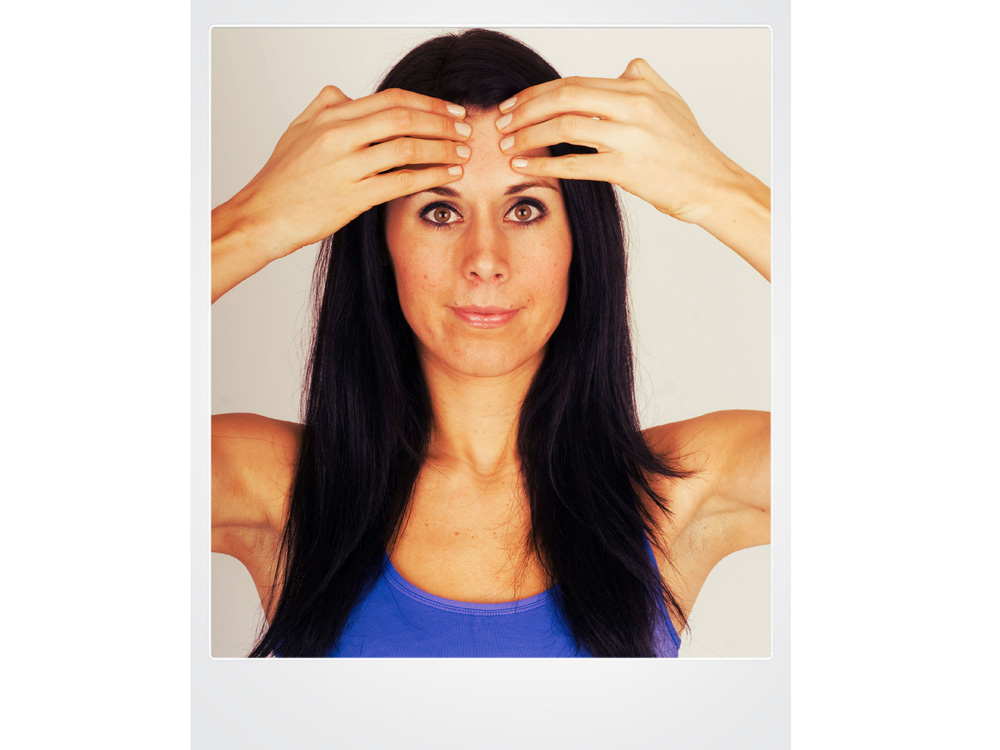
Place both hands on the forehead facing inwards and spread all of the fingers out between the eyebrows and hairline.
Step 2: Gently sweep the fingers outwards across the forehead, applying light pressure to tighten the skin.
Step 3: Relax and repeat 10 times.
4. The Flirty Eyes
Good For: Deep eye hollows and drooping eye brows.
Alternative To:
 Eyebrow lift.


Step 1: Place an index finger under each eye, pointing towards the nose.
Step 2: Hide the teeth and tease the top lip and bottom lip away from each other at the the mouth.
Step 3: Flutter the upper eyelids while gazing at the ceiling for 30 seconds.
5. The Giraffe
Good For: Lines and loose skin on the neck.
Alternative To:
 Neck lift and jowl lift.


Step 1:
 Looking straight ahead, place the finger tips at the bottom of the neck and lightly stroke the skin downwards with the head tilted back.
Step 2: Bring the head back down to the chest and repeat twice more.
Step 3: Finally, jut the lower lip out as far as possible to pull the corners of the mouth down and place finger tips on the collarbone with the chin pointed upwards. Hold for four deep breaths.

http://www.marieclaire.co.uk/blogs/544896/5-anti-ageing-facial-exercises-you-can-try-at-home.html 

Wednesday, 21 January 2015

How To Wake Up In The Morning Actually Feeling Rested And Refreshed

Quite frankly, we’re sick of waking up in foul mood and groggier than we were when we hit the sack a few hours earlier.


We long to be the kind of person who doesn’t want to throw our iPhone across the room when the alarm goes off, who can jump out of bed with a spring in our step as the first glimpses of sunlight creep around the curtains. And we’re not alone, according to The Body Clock Guide to Better Health: How to Use Your Body’s Natural Clock to Fight Illness and Achieve Maximum Health (St Martins Press), only one in ten of us are an ‘up-at-dawn, raring-to-go early bird’ kind of person. But what if you want to be that woman? Well, you can do this…


Light Up

Our bodies are designed to sleep when it’s dark and rise when it’s light. Nothing new there. But, our sleeping habits are far removed from what’s ‘natural’. We bathe ourselves in artificial light well into the evening with the TV, smart phones and iPads and we often wake before it’s light and drag our sorry behinds to the office. There are studies that suggest too that the blue light emitted from our smart phones and tablets interferes with our sleep hormones and so disrupt our nights. This is not as nature intended.
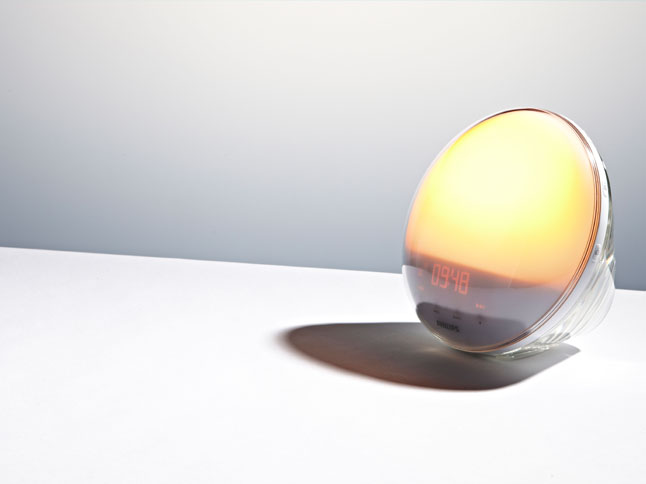
Studies show that we greatly benefit from waking up to light so when we have an early sunrise, as we do now, try sleeping with your curtains open. But even in winter when it’s dark outside, it’s still possible to wake with gradual light. Cheat a sunrise with an alarm clock that uses light to rouse you. We love the Philips Wake-up Light, £100. The light gradually increases from dawn reds, through to orange and finally a bright yellow 30-minutes before the time you have set on your alarm. Tests show that the majority of users feel as though they wake up better and find it easier to get out of bed.

Wake Up Slowly

There are five stages to sleep, and not surprisingly the fifth stage is when our body wants to wake itself up. Waking abruptly to an alarm completely ignores what our body wants to do. A deafening alarm clock – or even your smart phone – wakes us up too abruptly, it’s traumatic and disorientating, it causes our heart to jump and adrenalin to surge.
Waking up slowly feels far more natural to our bodies. A sunrise alarm clock will do the job of gradually rousing you.
Create the Right Atmosphere 

Our body temperature falls and rises throughout the day; it’s set on a 24-hour cycle. Our peak temperature occurs some time in the late afternoon and it’s at its lowest around 5am.
Temperature is important when it comes to getting a good night's rest and waking pleasantly. After all, a restful sleep is essential for a refreshed morning. Most experts agree on a room temperature between 60-67 degrees Fahrenheit (15- 19 degrees Celsius) – anything over 75 degrees Fahrenheit (23 degrees Celsius) and below 54 degrees Fahrenheit (12 degrees Celsius) is likely to disrupt sleep. They also agree that a cooler temperature leads to a deeper sleep.
Ventilation is really important at night too. We breathe in oxygen and breathe out toxic CO2 – if it’s safe to do so, sleep with your window open so that CO2 can be spirited away and clean oxygen can be returned in its place. Our body goes through a cycle of healing at night where it works to repair the free-radical damage it endures during the day. A healthy supply of oxygen is essential for this process and it will also help to regulate the temperature of your bedroom.
Rise Early 

Countless studies confirm that early risers are generally happier, healthier and more productive. A 2008 study by Texas University found that people who identified themselves as ‘morning people’ performed better in tests and in 2008 Harvard biologist Christoph Randler discovered that early risers are more proactive. 
Various other studies show that morning people exhibit character traits like optimism, being agreeable, satisfaction and conscientiousness while those of us that would consider ourselves to be Night Owls are more likely to exhibit traits like depression, pessimism and neurosis, despite being linked with creativity and intelligence.
What to Avoid 

An unsettled tummy leads to an unsettled night's sleep. Coffee, red wine and chocolate particularly have been scientifically shown to disturb sleep so avoid them before bed. A good rule in general is to eat your main meal earlier in the evening so that your body doesn’t spend valuable hours digesting your food while you sleep, which could be better spent.
Cut out the Noise

Since 2003 the WHO’s Working Group on the Noise Environmental Burden of Disease project has been looking at how noise affects our health and how to minimise the problem. Their research suggests that 2 per cent of Europeans suffer severely disturbed sleep because of noise pollution, and at least 15 per cent suffer severe annoyance. Double-glazing cuts road noise dramatically but there’s very little you can do to insulate yourself from your neighbours domestics. The quickest change you can make – apart from having it out with your neighbours – is to invest in some good earplugs.  
http://www.marieclaire.co.uk/blogs/547058/how-to-wake-up-well.html

Sunday, 18 January 2015

Facial Massage Is Just As Important For Anti-Ageing As The Products You Use. This Is Why...

Sure, the products you use make all the difference but without the proper facial massage, you could be wasting your time. Here are five techniques that will help roll back the years...

There's a reason your skin looks so good post-facial: The massage. An hour of careful facial massage will work wonders on ageing or tired skin, from lifting and firming to calming and soothing. But you don't need to head to a professional every time you want to reap the benefits of an hour-long treatment. There are tricks and tips you can use at home to see the same results. Think of our expert tips as a natural face lift - because this is what the right massage can do for your complexion. 


As we age, our skin loses the ability to replenish lost cells, which results in sagging skin and wrinkles. While a set of anti-ageing moisturisers is a good place to start when you notice the first signs of fine lines, a facial massage will really get your skin back to it's beautiful best.

Beauty insiders swear by facial massage, and when you think about everything your complexion goes through in a day, it makes good sense to treat it to a bit of TLC. Follow our easy how-to and learn to smooth and sculpt your face with a relaxing facial massage...

Sort Out Sagging: 
Don't believe the adverts, massaging your face in circular motions only drags at the skin without working the muscles at all. Your facial muscles are actually arranged diagonally in line with your cheekbones, so long, diagonal strokes upwards will engage with them and tighten up skin. 

Patter Out Puffiness: If you wake up with puffy skin, go for light tapping motions. This will stimulate the lymphatic system which lies just underneath the skin's surface and gets rid of excess fluid. Work towards your ears where the lymph nodes are located to flush it all out.
Good As New Neck: Thought you had to massage the neck upwards? Wrong, it's actually downwards to get rid of excess fluid being held there.
Oil It Up: Serums disappear too quickly to massage in so this is where you need face oil. Don't be scared, oils balance skin so even if you have oily skin you'll see the benefit in minutes.
Pinch Up Your Peepers: Pinching along your brows stops the upper eyelid sagging and lifts the appearance of brows.
Eliminate Eye Bags: Always stroke from inside of the eye socket outwards. If you do it the wrong way round (out to in) the other way can make eye bags even worse.
Want to know even more about these anti-ageing techniques? Discover face yoga...
 http://www.marieclaire.co.uk/blogs/jessica-lacey/545943/facial-massage.html 

Thursday, 15 January 2015

How To Cope With Stress: 18 Expert Tips That REALLY Work

Things can get a little overwhelming sometimes, and we can all suffer from moments of serious stress. But don't panic, we've spoken to top psychology experts to find out what you can do to banish that anxiety. Right now.

1. Rest up
'Ensure you get between 6 and 8 hours of good quality sleep a night,' says Dr Chris Bundy, Simple psychologist and senior lecturer at the University of Manchester. 

2. Exercise
'Go for a brisk 10-minute walk each day to improve your mood and lift your spirits,' says Dr Chris Bundy. 'So many of us spend too much time chained to our desks, but it's vital to get out at lunchtime and clear your head, putting your worries into perspective.'

3. Stay positive
'Don't dwell on the negative,' says Dr Chris Bundy. 'Try and focus on the positive things in your life and screen out the bad. Look back at happy photos, see friends, and practice focusing on one new, positive thing a day. This will help switch your thoughts from negative to positive.'

4. Don't fear failure
'We can all suffer from a crisis of confidence and worry about failure instead of working on our strengths,' says Dr Chris Bundy. 'Look forward and focus on what you want to achieve rather than what you have failed at in the past, and be realistic with your goals.'

5. Laugh it off
'Take time to smile and laugh,' says Dr Chris Bundy. 'It's the surest way to boost your mood, which will help alleviate stress.'

6. Keep a stress diary 
'Write down how you're feeling to gain insight into the early warning signs and symptoms that show you are stressed,' says Dr Gail Kinman, professor of Occupational Health Psychology at the University of Bedfordshire. 'Some people get headaches or become irritable. This will help you take action before things get worse.' 

7. Maximise social support
'This is the most effective way to offset stress at work,' says Dr Gain Kinman. 'Think about the people you have to support you, both inside and outside of work, and talk to them.'

8. Maintain boundaries
'It is vital to have effective boundaries between work and home,' says Dr Gail Kinman. 'Do something to physically separate the two, such as going for a walk, changing your clothes when you get in or phoning a friend for a chat.'

9. Make time to worry
'Designated worry time can be useful,' says Dr Gail Kinman. 'Set aside 10 minutes a day to spend worrying. If you find yourself becoming stressed during the day, write down your problem and forget it until your worry time. Most worries sort themselves out during the day anyway, and this will help to contain the anxiety.'

10. Take a break
'Sit down and take some deep breaths,' says psychotherapist Dr Emma Mardlin, of The Pinnacle Practice. 'Breathe in deeply through your nose, filling your lungs, and then exhale through your mouth. Do this several times, and it will help you think more clearly, while restoring a sense of calm.'

11. Question whether it REALLY matters
'Ask yourself whether the thing that is stressing you out is really that important in the grand scale of life,' says Dr Emma Mardlin. 'If you died tomorrow, would there have been any point in wasting time over it?'

12. Find the root cause
'You need to ask yourself what the stress is really all about,' says Dr Emma Mardlin. 'If you're struggling to get to the bottom of it, invest in seeing a good therapist who can assist you in this and help you release the problem or negative emotion once and for all.'

13. Express yourself
'Write it down or talk it through,' says Dr Emma Mardlin. 'This helps to externalise things and can take some weight off your mind, helping you see things in a different light. When you see things written down or hear them out loud, they often seem less awful.'

14. Make a list
'This can help eliminate the stress altogether,' says Dr Emma Mardlin. 'Make two columns on a piece of paper, one for "problems" and the other for "solution options". Think of all the possible ways you could resolve each issue. You should see this as an action list, and work through it gradually, doing what you can, when you can.'

15. Be grateful
'As soon as we start remembering what we are grateful for, our minds switch out of stress mode and into the relaxation response,' says psychological coach Nick Jankel-Elliott, author of The Switch: The Surprising Truth About Creativity And How To Rewire Ourselves To Break Through Anything. 'Think of as many things that you are grateful for as possible within one minute and write them down quickly, then look over the list.' 

16. Shake it off
'A remedy for stress is to shake, which immediately discharges the energy that has built up in your body and makes you feel better,' says Nick Jankel-Elliott. 'Put some music on and shake around the house, or simply flick your arms around in the loo at work.'

17. Find a purpose
'Research has shown that people who have a meaningful life are less stressed,' says Nick Jankel-Elliott. 'Having a meaningful life means finding something that is more important than just yourself to focus on. It could be your family, your relationships or a project.'

18. Help others
'It has been shown that people who volunteer and give their time to others are happier, healthier and less stressed than those who don't,' says Nick Jankel-Elliott. 'They even live considerably longer, so find something that you feel is worthy of your time, and give your ideas and support to it.'

http://www.marieclaire.co.uk/blogs/544669/how-to-cope-with-stress-tips-from-the-experts-that-really-work.html 

Monday, 12 January 2015

10 Things You Need To Drop To Stay Motivated

You are constantly struggling with staying motivated. You start things but you never complete them. The excitement that you had in the beginning of your journey slowly fades. Does this sound familiar?
In order for you to stay motivated you have to get rid of things that are weighing you down. Below you will find 10 things you need to drop in order to stay motivated.

1. You will need to drop the sense of entitlement

You are not entitled to anything in this world. We all have “started from the bottom.” Work hard to accomplish your goals. You got this.

2. You will need to drop stress

Stop stressing yourself out over things you can’t control. Reduce stress by keeping your mind, body and soul active. Exercise, play sports, get yourself a companion (animal), write, etc. We all have to deal with stress in our life. The key is how you deal with it. Learn how to ignore things that stress you out.

3. You will need to drop negativity

Focus on the positive and drop negativity. Dropping negativity means that you distance yourself from negative people and negative influences. Distance yourself from people that do not care about your dream. Learn how to combat negative self-talk with positive affirmations.

4. You will need to drop comparisons

“When you are content to be simply yourself and don’t compare or compete, everybody will respect you.” – Lao Tzu
Stop comparing yourself to other people. Focus on your life. Live your life. Comparisons can make you envious and jealous of others.

5. You will need to drop time management issues

“Don’t watch the clock; do what it does. Keep going.” – Sam Levenson
A lot of people struggle with time management and blame this for the lack of motivation. Drop the time management issues and learn how to manage your time better. Check out this awesome list of one-minute time hacks.

6. You will need to drop impatience

Impatient people usually do not follow through with their plans. Do not become this person. Understand that it takes time, effort and energy to stay motivated. Visualize success on a daily basis.

7. You will need to drop the lazy attitude

“The secret of getting ahead is getting started.” – Mark Twain
Drop the lazy attitude and focus on your work ethic. Give 100% day in and day out. Become the person that people enjoy being around. Remind yourself that you are destined for greatness. Get up earlier. Do the harder tasks first. 

8. You will need to drop the ungrateful mindset

“An ungrateful man is like a hog under a tree eating acorns, but never looking up to see where they come from.” – Timothy Decker
Drop the ungrateful attitude and be thankful for the life that you are living. Be thankful for where you are and where you will be in the future.

9. You will need to drop the serious mentality

Put a smile on your face. Laugh a little bit. Okay, so you have dealt with a few things in your life. But still, please stop being serious and live life. Enjoy the presence of others. Spend time with your family. Progress towards a bigger goal by making smaller, realistic goals.

10. You will need to drop the excuses

Drop the excuses. Nobody wants to hear them. Stop looking for people to blame. Stop pointing a finger at others and start pointing a finger at yourself. Look at the person in the mirror and address what is holding you back.

We hope you enjoyed this motivational boost. If you find this information helpful please share it with your friends and family.

http://www.lifehack.org/articles/communication/10-things-you-need-drop-stay-motivated.html

Friday, 9 January 2015

Questions and answers regarding wealth and money

Money is simply a vehicle and it allows you to translate your dreams and aspirations into forms and you can accomplish things with economics. People say money can’t buy you happiness – happiness and sadness is part of the equation of life no matter if you are impoverished or wealthy. I know some very vastly wealthy people who have happiness and sadness just like the impoverished people. But, what money does is change the opportunities in life and lifestyle that people deserve. If you go to a hamburger joint, you might get a 16-year-old kid who is flipping a hamburger, who is not inspired and needs a job and is just doing it. But, if you go to the finest restaurants on the planet, you are going to see an artist inspired about what they do and love it and they are going to put love and energy into that food like you’ve never seen before. You’ve got to ask where do you want to hang out? Do you want to hang out with the people who are not inspired and eat the food of that vibration, or hang out with the people who are making a piece of art and history with their food – where do you want to play in the game of life? I would rather surround my life with inspirations and the finest things that life has to offer, and I believe that there is enough abundance that we can do that.

This month I thought it is wise to share with you some of my answers to the questions that I have received from students regarding wealth as I believe these will assist you in taking your wealth building potential to a new level of financial return.

Q. Why do so many people never obtain financial independence?

A. I believe the primary reason is because of the hierarchy of someone’s values. The world’s values are not geared toward financial prosperity and wealth building. Many times you will find someone who’s highest value is to ensure that they have an education, or their highest value is their children, socialising or their religious beliefs, but building wealth and becoming financially independent; even though many people may say they want to be wealthy, that is not on the top of their value list. They live their life according to their value list, and they have other things stacked on top that is more important; and as such, they spend their money on those things before they ever save it. They end up paying themselves last and saving very little and end up in that percentage that doesn’t end up financially independent.

Q. Why is Money a means of exchange for services rendered?

A. When you have fair exchange with somebody, that means you are basically communicating something and offering something that is valuable to you in terms of what’s valuable to them and they appreciate that. If you give someone something and they don’t pay you, they have the guilt of not doing it, and you have the fear of not receiving it, and both of you are out of presence. But, when you have payment when services are due at the same time, it’s clean, it’s done – there’s no fear generation or guilt generation, it’s present and complete and a completed, clear mind is more powerful to create than one that is filled with fear and guilt.

Q. Does having a plan for what you want to do with money help you build wealth?

A. Imagine going into a company and asking for a job or a promotion in a position that you have no idea what you are doing – why would they give it to you? It’s the same thing with economics, studying wealth and what you are going to do with each dollar allows you to have a clear, crystallised vision of how you are going to manage it; and what you are going to do with it, and you are a lot more likely to get that opportunity, than if you had no idea what you are going to do. Why would you get anything if you didn’t have the plans and ideas on how you are going to manage it?

Q. Do you have to have money as one of the top three values if you truly want to be wealthy?

A. If you are not going to put wealth up as one of the higher values, you are not likely to manifest wealth in your life. You have to have it up on the value list if you want to manifest it. If you have ten thousand dollars coming in to you, and you’ve got building wealth as number thirty on your list of goals and values, and all of sudden you are expecting to build wealth with it, you are going to have twenty nine things that you are going to spend your money on before you ever save. So, when somebody finds that they want to be wealthy and they have it as number thirty on their list, I tell them it’s not going to happen until you have it higher up on your list. If saving is not up on the top of the list, you will never get around to saving. You will procrastinate on things that are lower on the value list, and you’ll act on the things that are higher in your value list.

Q. Why must you have a cause for wealth?

A. Wealth is going to be proportionate to your cause. The greater the cause, the greater the wealth. If you have a small cause and just want to survive and have enough money to just make ends meet, then forget wealth; you’re not going to have financial independence, you are just going to have enough food to eat. But, if you have a cause to build a park in my community and buy a piece of land and build a park for all of the kids so they don’t have to walk across the busy intersection to go to the park; now you are going to rally more energy and boost to building wealth for that cause. If you are going to build an organisation for a health concern that is a city or statewide venture, you are going to build even bigger wealth. So, the size of your cause will decide your motivation and the size of the wealth that you can accumulate.

Q. Why is it essential to resolve guilt to build wealth?

A. When people don’t feel worthy, they feel guilty. They assume that they caused in the past to someone else through their motor functions – some loss without gain, or negative without positive, or pain without pleasure and they feel guilty and when they do, they lower their self worth. Thus, they don’t feel worthy of receiving things and they set up little traps and sabotaging systems to interfere with building wealth because they don’t feel a deserving level. It’s wise that if you feel guilty about something to think whom you feel guilty in relationship to. Ask yourself that whatever you did how did it serve them and you? Then, bring it back up until you feel worthy of receiving.

Q. What is an immortal savings account and why is it necessary to have one?

A. An immortal savings account is one that you save that lasts beyond, to a cause that’s bigger than you that goes on beyond your mortal life. For example, let’s say that you save enough money and become financially independent and your investment income overrides your active income from work, and then you want to create something that lasts beyond that. That is want foundations are for and if a person builds a wealth base that out does their own life, then they can contribute to something philanthropically and there’s a certain fulfilment in the ability to serve humanity. So, if a person starts an immortal account, they can actually contribute to goals that they have set even though they have passed away.

Q. How should one handle debt?

A. I like to think of debt as somebody who has already invested in you and they deserve to be thanked. People usually see their debt and get all bent out of shape and frustrated about how much they owe, but I look at it as somebody gave you money, believed in you and they are investing in your little stock market. It’s wise to take your investors and thank them for contributing to you – they’ve made it possible for you to do what you do. Then Turn debt into service and focus on the service. Don’t focus on the debt; focus on the service. Thank the debt and focus on the service. Let’s say that you owe a hundred thousand dollars and you have to pay a thousand dollars a month for it. What you do is divide that up in the number of days that you work – let’s say twenty,a month which means you have to make fifty dollars a day. Then, you divide it up into whatever products, service or idea that you are selling. Next, find out how many products, service or ideas you have to sell to make that fifty dollars and then you covert the debt into the service and concentrate that much more on your service. When you focus on converting debt into service and concentrate on serving people, the debt goes away. If you concentrate on the debt and not the service, the service goes away.

I hope that these answers help you in addressing some of your wealth building questions and remember, anything that you are infatuated with, runs you and anything that you resent, runs you. If you get elated and depressed about things, it runs you. It’s best to have strategies that override emotions. Money is made from strategies not emotions. As Warren Buffett said, ‘Until you can manage your emotions, don’t expect to manage money!

http://blog.drdemartini.com/money-simply-vehicle-allows-translate-dreams-aspirations-forms-can-accomplish-things-economics/

Tuesday, 6 January 2015

10 INSPIRING BUSINESS LESSONS

1. Confidence Trap
When you’re busy you often accomplish and create much more. The more intensely you’re focused and active and the longer you maintain such a focus, the faster your accomplishments. Time spent on doubt, fear, or low-priority actions slows down your accomplishments. When your mind is focused on your dreams, you don’t have time for the many self-doubts that block them.

2. Raise Your Standard
Anything you do takes time. To maximise the value of your time, prioritise your interactions. People who seem less busy and want to consume your time may think you’re being rude when you say no to their invitations, but busy people understand immediately that you’re just choosing to prioritise and wisely manage your time.

3. Efficiency and Effectiveness
Often when you perform a service for less than you feel you deserve you lower your worth and enthusiasm and slow your business. Any aspect of your work that pays less than you truly feel you deserve can become your business’ weak link. In addition to undermining your motivation, inefficiency and ineffectiveness can also reduce profit margins. Your worth can be determined by how efficient and effective you are at performing high-priority actions. Business masters are those who love what they do, do what they love and work efficiently and effectively. They delegate everything else to those who desire to do the same.

4. Desperation vs Inspiration
When you hire, don’t rescue desperation. Anyone who says, “I’ll work for anything, I’ll do anything, you can pay me whatever you like,” is desperate and if you hire desperation, you’ll breed it in your business. You can train many skills, but inspiration isn’t easy to develop and takes work. Take the time to evaluate the whole person, not just their curriculum vitae.

5. Busy-ness
When you have fewer demands, you become more easily distracted and/or anxious. When your employees have fewer demands, they become less productive, so keep your employees busy, focused and inspired. If you’d like your employees to be productive, give them a bit more than they think they can do, and they’ll do more than they ever thought possible.

6. Working on Your Business
Business fulfilment doesn’t automatically result from hard work; working smart is just as important. Part of that is raising your fees. Knowing all the details and costs of your business is vital. Knowing where you stand financially tells you how flexible or firm you can be and prevents you from making unwise business decisions. So work out all of your costs and put a true value on yourself and your business. It will pay handsomely in the long run, saving you years of undervalued work.

7. Prosperity and Austerity

Everything occurs in cycles. In times of perceived prosperity, you’ll feel elated, optimistic, and complacent and you’ll stop doing the things that brought you there and the demand for your product or time will drop off while your supply goes up. In times of perceived austerity, you’ll feel depressed, pessimistic, and impatient. Then you’ll become creative, go back to the basics and act purposefully once again. As your demand goes back up and your supply goes down, you return to the prosperity side of the cycle. It’s a circle and money dips are an essential part of it until you develop discipline.

8. Feedback
Make sure you request feedback about your products and services, to keep refining and evolving what you do and how you do it. Not every suggestion will be of the greatest value, but by being selective you can receive tremendous feedback.

9. Work and Play
In your business career, you’ll experience moments of work and play, seriousness and humour, tragedy and comedy. Embrace them all equally, for they will help you remain centred and focused. If you make your business too serious, some employee may try to create fun to provide the balance or they will feel urges to take time off and get away to express their playful side. Put work and play together and you and your employees will be more integrated, energetic, and inspired.

10. Put Your Heart in It
When you truly appreciate and value where you are and the products or services you offer, so will others. Whatever you think about and focus on with inspiration is what you attract into your life. It’s a basic law of business. Until your innermost dominant thought is your clients, don’t expect their innermost dominant thought to be your business. When they are on your mind, you are on their mind.

http://blog.drdemartini.com/10-inspiring-business-lessons/

Saturday, 3 January 2015

10 Ways To Become a Millionaire by Age 30

It may seem like an impossible goal to be a millionaire at any stage of your life. However, that isn’t true. The earlier you start making smart financial decisions, the more likely you are destined to being a part of the millionaires club later in life. However, we are in an age where simply storing money away doesn’t garner more in the future. You have to employ a combination of methods that not only set aside money you contribute, but also compounds it with interest. Today, we will talk about ten ways you can grow your net worth for a more stable future.
If you’re born poor, it’s not your mistake. But if you die poor, it is your mistake.” Bill Gates

Increase Your Income

The first step to becoming a millionaire is having the capital to fund your investments that will compound your money. To get this money, legally, you’ll need a stable job. You should work to always make yourself marketable as a way of not only maintaining your current job, but moving up the ladder to a better position or company. If you are in the technology sector, consider to stay on top of tech news and improvements. Even if you are outside of the tech industry, learning a few technical skills can improve your income. Always focus on increasing your income, even if you are currently comfortable.

Live Frugally

You may feel that individuals who are millionaires are the ones who drive flashy cars and own the latest gadgets. That isn’t true in most cases, and shouldn’t be in your case if you are looking to work your way to millionaire status. To maintain your income’s growth, this is the time when you have to seek out the clearance rack or sales. Never accept retail price, it simply isn’t worth it. This is the case in grocery stores, shopping malls, the internet, or even club/gym memberships.

Plan to Invest

You may feel that your piggy bank of savings is smart saving. However, it truly isn’t. All you are doing is have your money sit there unproductively. It isn’t gaining interest. This is the case even for many standard savings accounts. Simply having a savings account isn’t enough, but it is a good start.
When saving it is important to remember to save to invest, not save to save. Look into ways in which you can get started creating a portfolio of investments for yourself. Etrade is a great start that is easy to navigate. Acorns is also an up-and-coming option that makes diversified investing more approachable for the common individual.

Shed Unproductive Debt

There is no such thing as good debt. Even “good debt” as some coin it is still money that you don’t have easy access to and doesn’t have the 100% guarantee is materializing into a profit later on (a house, for example). However, there are examples of productive and unproductive debt as I will coin it. Productive debt can be a credit card. Yes, every time you swipe a credit card, you are creating debt because it doesn’t get paid off until you pay your statement.

However, if you spend within your means or only on certain expenses, many credit cards come with reward dollars or cash-back. This is the credit card (one, not multiple), that you should seek. It’s technically free money ($6 back on $200 of groceries, for example). These reward and cash-back dollars add up and can result in savings. Below is a list of three great cash-back credit cards:
  • Discover It Card
  • American Express Blue Cash Everyday
  • Chase Freedom

Manage Your Money

The only way to grow your money is to know where it all is and where it’s going out. Download the Mint application for your smartphone. This will allow you to stay on top of your (almost) total net worth from your bank accounts, credit cards, and investments. While not all financial services and institutions are supported yet, it gives you a detailed look at the financial aspects of your daily life. Set up isn’t very lengthy and once set up, it updates automatically whenever you open the application. Having a holistic look at your finances makes savings easier and even offers an incentive to save.

Follow the 50/20/30 Budget

Once you get your pay check, every cent of your money should be earmarked or you’ll find yourself spending like crazy. You may feel it’s daunting to have to spend every cent of your pay check each month. However, to spend in this case isn’t to hit the stores. Instead, allocating is a better term. With the 50/20/30 budget created by Elizabeth Warren, 50 percent of your income goes to the essentials (groceries, rent, essential utilities), 20 percent goes to savings (savings account, portfolio additions, Roth IRA contributions etc), and the remaining 30 percent goes to what is considered “lifestyle choices). This includes restaurants, your cell phone, clothing, etc. Below, we have an example for a individual earning $51,000 a year:

Base Salary – $51,000
After Taxes (25%) – $38,250
  • Essentials (50%) – $1593.75/month
    • Utilities – $80
    • Groceries – $250
    • Gas – $80
    • Rent – $1000
  • Savings (20%) – $637.50/month
  • Savings Account – $300
  • Loan Repayments – $200
  • IRA/Portfolio Fund – $100
  • Discretionary Spending (30%) – $956.25/month

Grab the Free Money

It is amazing how much free money is ignored by individuals. One of the most common ignored sources of free money are programs offered through your employer. Some can be in the form of student loan payment assistance. For other employers, there is the option of a 401K contribution match.
For example, if you contribute X amount each month, your employer will match the contribution either by 100 percent or even at least 50 percent. While usually to a certain limit, around $6000, that’s six thousand dollars you didn’t have before and wouldn’t have had if you didn’t ask. Make sure you stay informed on these options, not just before getting hired, but also periodically. Many times, such programs can be added later on.

Keep Accounts Manageable

As we mentioned before, managing your accounts through services like Mint is smart. However, having a ton of multiple accounts and cards can not only be confusing, it could hinder you from becoming a millionaire sooner. While diversifying income streams is great, outgoing streams should be kept as simple as possible. Multiple credit cards can mean having to keep up with multiple due dates, and in many cases, multiple credit pulls. Along with possible monthly or yearly fees, these multiple outgoing streams can even encourage you to spend more than you intend.

Save for the Right Reasons

Just as we mentioned before, to save for investments, it is also important to ensure that you saving in multiple departments with a goal in mind. While you savings and investment accounts are multiplying with the goal of becoming a millionaire by 30, you day-to-day savings should have a reason as well. You may remember the multiple times you encounter a sell on shoes and because it is 25 percent off last week’s price, you feel that you are making a good economic decision by buying this sale item.

Not exactly! Those shoes aren’t something you necessarily need, and the $X you spend on your shoes is still an outgoing expense that could be saved or utilised elsewhere. While enjoying that 30 percent of your 50/20/30 budget is important, it’s still important to bargain hunt with a purpose. Gain satisfaction through the deals you gain on bills, groceries, and household necessities, not clothing or other expenses that wouldn’t have been in your scope of attention before the sale appeared.

Be Committed

In the end, you have to be committed to this goal. It is a long-term goal that will continue to go on well after you make your first $1 Million. It’s important to not live with the hope of dying with $1 Million net worth, but to have a $10 Million or even $15 Million net worth.

Aiming high ($10 Million) makes still exceptional goals ($1 Million) more possible. Having an individual (a family member or friend) who you can attest is doing well financially can be a great way to ensure you are on the right track. Everything they say can’t be taken word-for-word, everyone’s economic situation is subjective. But having them as a role model will ensure that you aren’t in this alone.

http://www.lifehack.org/articles/money/10-ways-become-millionaire-age-30.html